


Dangerous Goods Logistics Market: How Safety, Regulation and Technology Are Reshaping Global Supply Chains
Why Hazardous Cargo Is Becoming a Supply-Chain Priority
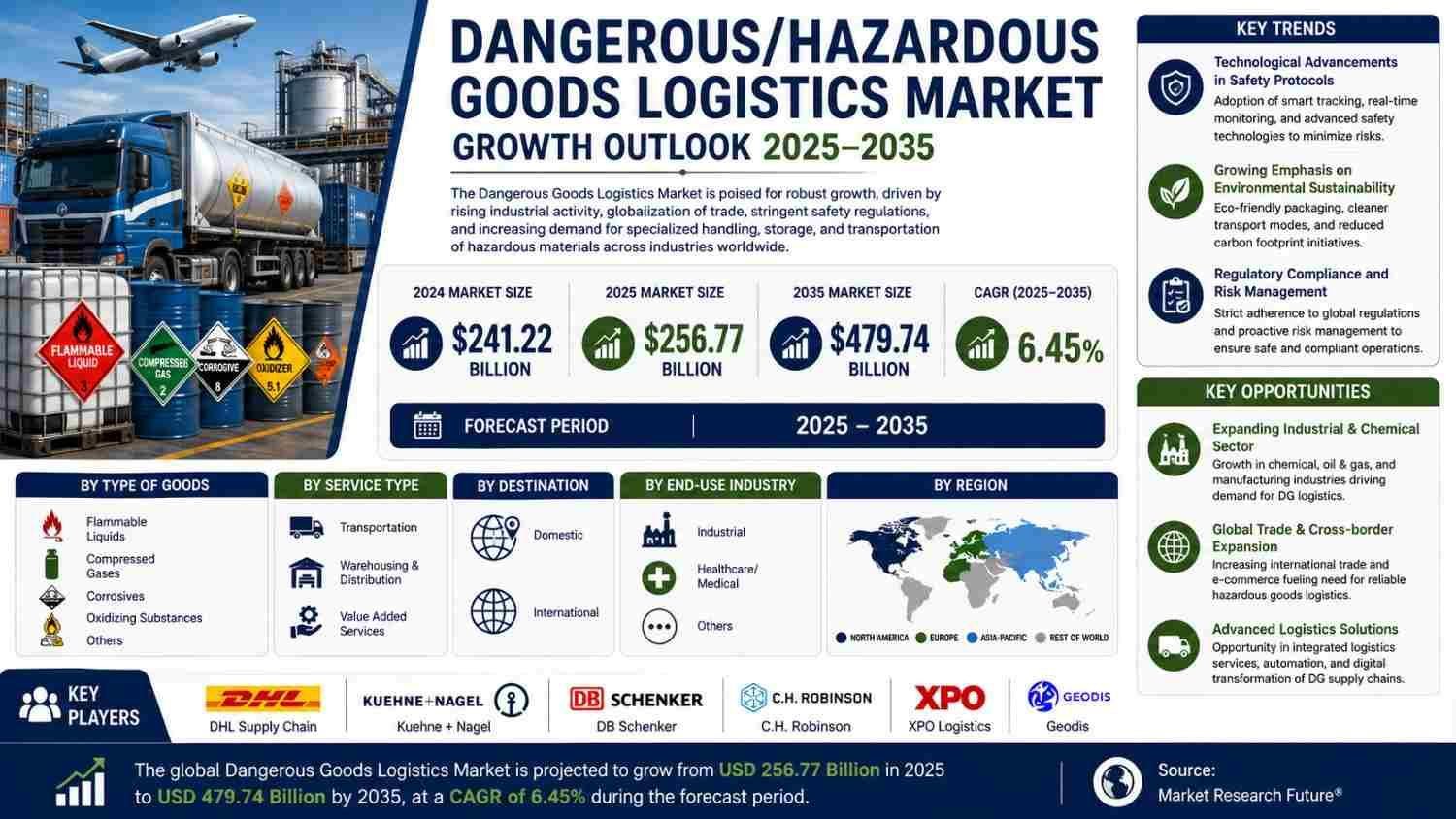
Moving hazardous cargo is fundamentally different from moving ordinary freight. A shipment containing flammable liquids, compressed gases, corrosive substances or oxidizing materials carries consequences that extend beyond delivery delays: packaging integrity, route selection, storage conditions, documentation and emergency preparedness can all determine whether a shipment reaches its destination safely. That complexity is giving the Dangerous Goods Logistics Market a more strategic role in global commerce. The market was valued at USD 241.22 billion in 2024 and reached USD 256.77 billion in 2025. It is projected to reach USD 479.74 billion by 2035, representing a CAGR of 6.45% from 2025 to 2035. Behind those figures is a practical shift: manufacturers, healthcare organizations and industrial companies increasingly need logistics networks capable of managing risk as carefully as they manage transportation cost.
Hazardous-goods logistics includes transportation, warehousing, distribution and value-added services. Its importance rises whenever an industry depends on materials that are essential to production but difficult to handle. Chemicals are required for manufacturing, gases support industrial and medical operations, corrosive materials are used across processing industries, while specialized substances move through pharmaceutical and healthcare supply chains.
The market therefore reflects more than freight demand. It reflects the growing complexity of moving materials safely across increasingly interconnected supply chains.
Why More Industries Need Specialized Logistics
Industrial production is one of the largest sources of demand because chemical inputs rarely remain within a single geographic market. Manufacturers may source raw materials internationally, process them at regional plants and distribute finished products across multiple countries. Every additional border, warehouse or transport mode introduces another point at which compliance and handling procedures must be maintained.
Healthcare adds another layer. Medical and pharmaceutical supply chains can involve chemicals, gases and other controlled materials that require careful packaging, storage and transportation. Reliability becomes particularly important when the material is connected to clinical operations or manufacturing continuity.
The industrial and healthcare sectors also demonstrate why specialized logistics providers can create value beyond transportation. A standard carrier may move a package from one location to another, but hazardous-goods logistics requires classification, documentation, trained handling, compatible storage and risk controls throughout the journey.
That creates demand for logistics providers with specialized infrastructure and operational knowledge.
Technology Is Moving From Visibility to Risk Prevention
Technology is changing hazardous-goods logistics because operators need more than confirmation that a shipment has left a warehouse. They need to understand where the shipment is, what condition it is in and whether an emerging problem could compromise safety.
Digital tracking platforms can connect shipment information, location data and operational alerts. Sensors and connected devices can potentially provide information on environmental conditions, while automated warehouse systems can reduce manual handling in controlled facilities.
The more valuable development is the integration of these technologies into decision-making. A visibility platform can help identify delays, but a more sophisticated system can connect route information with shipment characteristics and operational risk. That distinction matters when a delayed hazardous shipment cannot simply be redirected through any available facility.
Automation can also reduce unnecessary human exposure during repetitive handling tasks. In warehouses, digital inventory systems and automated movement equipment can improve traceability while reducing manual intervention.
However, technology does not eliminate operational responsibility. Sensors need reliable calibration, data needs secure management and employees still need the expertise to interpret warnings and make decisions.
Transportation Mode Determines the Risk Equation
Road transportation remains important because hazardous materials frequently need flexible, door-to-door movement between production plants, warehouses and customers. Specialized tanker trucks and compliant packaging are therefore central to many supply chains.
Sea freight becomes important when materials move across long international distances. Its economic advantage for large cargo volumes must be balanced against requirements for secure packaging, container compatibility and careful documentation.
Rail can offer an alternative for certain bulk movements, particularly where established industrial corridors exist. Air freight serves time-sensitive applications but typically faces tighter operational constraints because of the nature of many hazardous materials.
The practical challenge for logistics companies is therefore not simply choosing the cheapest mode. It is matching the cargo's characteristics, urgency, distance, infrastructure and regulatory requirements to the appropriate transportation system.
Regulation Is a Commercial Requirement, Not an Administrative Detail
Hazardous-goods logistics operates under a dense framework of safety and transportation requirements. Classification, labeling, packaging, documentation and handling procedures can vary according to the material and route.
For logistics providers, compliance has become part of commercial performance. A shipment delayed because documentation is incomplete can disrupt production schedules. Incorrect handling can create much larger consequences.
This makes compliance capabilities a competitive differentiator. Providers that can integrate documentation, shipment tracking and operational procedures into a unified workflow can reduce friction for customers operating across multiple markets.
The challenge is that regulations and customer requirements can change, while international shipments may pass through several jurisdictions. Logistics providers must therefore maintain processes that are adaptable rather than dependent on static paperwork.
Where New Opportunities Are Emerging
One major opportunity lies in digital risk-management platforms. Visibility is becoming increasingly valuable because customers want a clearer understanding of hazardous shipments from dispatch through final delivery.
Another opportunity is specialized warehousing. As chemical, healthcare and industrial production expands into new regions, companies need storage facilities capable of handling specific categories of hazardous goods safely.
Sustainability is another emerging consideration. Logistics companies are under pressure to reduce emissions without compromising safety. Route optimization, better vehicle utilization, alternative transportation options and more efficient warehouse operations can help address both environmental and economic objectives.
Emerging markets could also create new logistics demand as industrial capacity expands. The opportunity is not simply to add transportation capacity, but to establish compliant infrastructure before supply chains become more complex.
Regional Markets Reflect Industrial Structure
North America benefits from its extensive industrial base, chemical production, healthcare infrastructure and sophisticated logistics networks. The region also has mature regulatory and safety systems that encourage investment in specialized logistics capabilities.
Europe presents a different but equally important environment. Dense cross-border trade means logistics providers must manage multiple regulatory contexts while serving highly integrated manufacturing and chemical industries. Sustainability expectations also influence logistics decisions.
Asia-Pacific is increasingly important because of its manufacturing scale, industrial expansion and growing international trade. The region's expanding chemical, pharmaceutical and industrial sectors create demand for specialized movement and storage services.
The Rest of the World includes markets where industrialization and infrastructure development can create new opportunities, although logistics maturity and regulatory consistency can vary considerably.
Competition Is Moving Beyond Transportation
The competitive landscape includes DHL Supply Chain, Kuehne + Nagel, DB Schenker, C.H. Robinson, XPO Logistics and Geodis. Their relevance comes from the broader capabilities required to manage complex freight networks rather than from transportation capacity alone.
Large logistics providers can compete through geographic reach, specialized facilities, digital visibility systems and integrated supply-chain services. Customers increasingly value providers that can coordinate multiple stages of a shipment rather than requiring separate arrangements for transportation, storage and compliance.
This creates a gradual shift from freight execution toward logistics orchestration. The provider that can combine operational reliability with digital transparency has a stronger position when customers are managing high-risk cargo.
What to Watch Through 2035
The market's next phase will likely be shaped by three connected forces: stricter risk management, deeper digitalization and changing environmental expectations.
Autonomous systems may eventually influence controlled logistics corridors, but adoption will depend on safety validation and regulatory acceptance. Artificial intelligence and predictive analytics may have a more immediate role in identifying delays, optimizing routes and improving asset utilization.
Sustainability will also become more operational. Companies will need to reduce emissions while maintaining the packaging, vehicle and storage standards required for hazardous cargo.
The most important question is therefore not whether hazardous goods will continue moving through global supply chains. They will. The more important question is how efficiently companies can build logistics networks that make safety, visibility and compliance part of the transportation architecture itself.
Market Outlook
The projected increase from USD 256.77 billion in 2025 to USD 479.74 billion by 2035 illustrates the expanding economic importance of specialized hazardous-goods logistics. But the stronger industry signal is structural rather than numerical.
As industrial supply chains become more international and materials become more specialized, hazardous cargo cannot be managed as ordinary freight with additional paperwork. It requires dedicated infrastructure, trained operations, digital visibility and disciplined risk management.
The companies best positioned for the next decade will be those that make these capabilities work together. In hazardous logistics, reliability is not simply about delivering on time. It is about delivering safely, compliantly and with enough visibility for every participant in the chain to make informed decisions.
Another Trending Topics
 Romaian
 English
 Arabic
 French
 Spanish
 Portuguese
 Deutsch
 Turkish
 Dutch
Dutch
 Italiano
 Russian
 Portuguese (Brazil)
 Greek
Greek
