


India Construction Chemicals Market: How Urbanization Is Reshaping Building Performance
Why Construction Chemicals Are Becoming Essential to India’s Building Boom
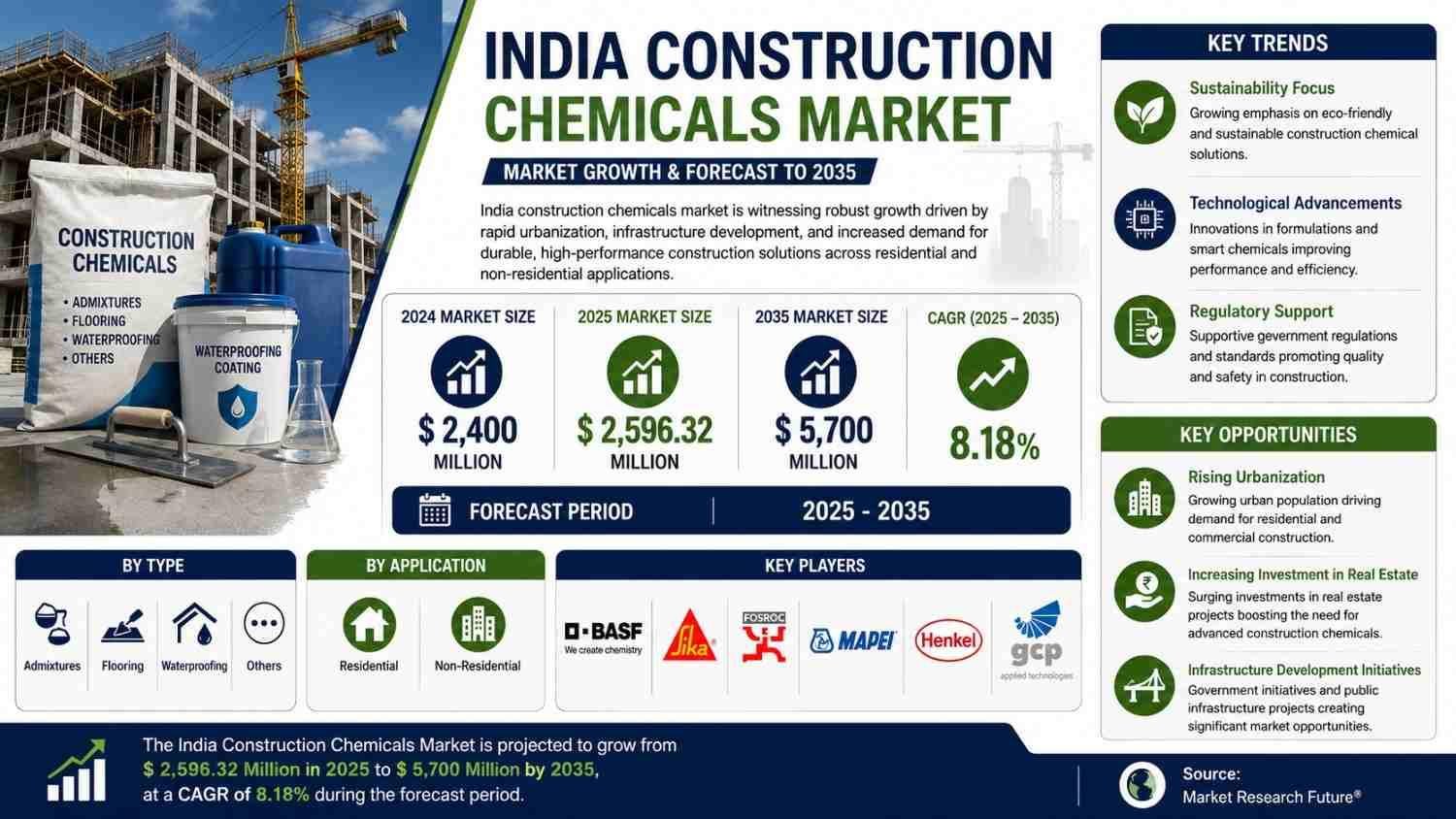
India’s construction sector is no longer being judged only by how quickly structures can be completed. Durability, water resistance, energy efficiency, lifecycle costs, and the ability to withstand demanding environmental conditions are becoming equally important. That shift is creating a broader role for the India Construction Chemicals Market, which was valued at USD 2.40 billion in 2024 and reached USD 2.60 billion in 2025. The market is projected to reach USD 5.70 billion by 2035, representing a CAGR of 8.18% from 2025 to 2035. Behind that expansion is a straightforward industry change: builders increasingly need chemical solutions that allow concrete, floors, walls, joints, and building envelopes to perform for longer under increasingly demanding conditions.
Why Urbanization Is Creating More Demand for Performance Materials
India’s urban expansion is increasing the volume of construction, but volume alone does not explain the growing use of construction chemicals. The more important change is the complexity of the structures being built.
High-density residential developments, commercial buildings, industrial facilities, transportation infrastructure, and large public projects require materials that can address specific performance problems. Concrete must often be easier to place, stronger after curing, more resistant to water penetration, and capable of meeting project requirements within tighter construction schedules.
Admixtures are particularly important in this environment because they can alter concrete performance without requiring fundamental changes to the structural material. Plasticizers and superplasticizers can improve workability, while accelerators and retarders allow contractors to manage setting behavior under different site conditions.
Waterproofing solutions address another persistent construction problem. Moisture intrusion can deteriorate structures, damage finishes, encourage maintenance problems, and shorten service life. As buildings become larger and more complex, waterproofing is increasingly treated as a performance requirement rather than an optional finishing step.
Concrete Performance Is Becoming a Commercial Issue
For developers and contractors, the economics of construction chemicals extend beyond the initial purchase price.
A chemical solution that improves concrete workability or reduces water penetration may influence labor requirements, construction schedules, repair costs, and the long-term maintenance profile of a structure. This changes how construction chemicals are evaluated.
The industry is therefore moving from a commodity-oriented approach toward more application-specific solutions. Contractors need products suited to different climatic conditions, concrete formulations, construction methods, and project requirements.
Superplasticizers are a useful example. Modern projects may require concrete that remains workable while maintaining a relatively low water-to-cement ratio. The ability to achieve that balance can influence strength and durability without simply adding more cement.
Flooring systems are also gaining importance as commercial, industrial, and residential properties demand surfaces that can withstand traffic, chemicals, abrasion, moisture, and repeated cleaning.
Sustainability Is Moving Beyond a Marketing Message
Sustainability is becoming a practical consideration for India's construction chemicals industry because the construction sector faces pressure to reduce resource consumption and extend building lifecycles.
A durable structure can reduce the frequency of repairs and replacement work. Waterproofing can help protect structural elements from moisture-related deterioration. Admixtures can support concrete formulations designed to achieve required performance with more efficient material use.
However, sustainable construction chemicals are not automatically sustainable simply because they are described as environmentally friendly. Their environmental profile depends on raw materials, manufacturing energy, transportation, chemical composition, application efficiency, and end-of-life considerations.
This creates room for manufacturers to differentiate through measurable performance rather than broad environmental claims. Products that combine durability, resource efficiency, lower waste, and practical site performance are likely to receive greater attention from large construction projects.
Technology Is Changing What Contractors Expect From Chemicals
Technological advancement is influencing both product formulation and application.
Construction chemical manufacturers are developing more specialized formulations designed to work under specific performance conditions. This includes products aimed at improving concrete flow, setting control, water resistance, adhesion, and surface durability.
Digitalization is also gradually changing project management. Better monitoring of construction processes can help contractors identify where material performance is falling short and where chemical solutions may improve consistency.
The result is a closer relationship between chemical suppliers and construction companies. Instead of simply supplying a product, manufacturers increasingly need to understand the project's concrete mix, environmental conditions, application method, and expected service life.
Where Demand Is Concentrating
The market's application structure reflects the broader development pattern of India.
Residential construction creates demand for waterproofing, flooring, concrete admixtures, and other solutions that help protect buildings from moisture and improve finishing quality. Non-residential construction expands the opportunity further because commercial and institutional buildings can require specialized flooring, waterproofing, repair, and concrete-performance systems.
Infrastructure represents another important demand channel. Roads, bridges, transit facilities, airports, industrial corridors, and other large projects place significant demands on concrete durability and construction efficiency.
The common factor across these applications is that chemical products are increasingly being used to solve specific construction problems rather than simply enhance aesthetics.
The Market Still Faces Practical Barriers
Cost remains one of the biggest barriers to wider adoption, particularly in price-sensitive construction segments.
Contractors may compare the upfront price of a chemical solution with conventional construction practices even when the chemical product can reduce lifecycle costs. This creates a challenge for suppliers because the economic value of better durability is not always visible at the time of purchase.
Application quality is another concern. Even a high-performance chemical product cannot compensate for poor surface preparation, incorrect dosage, unsuitable mixing, or inadequate curing.
Supply consistency also matters. Construction projects operate on strict schedules, and delays in obtaining specialized materials can disrupt work. Manufacturers with reliable distribution networks and technical support therefore have an advantage beyond product formulation alone.
Where the Next Opportunities Are Emerging
The strongest opportunities are likely to appear where India's construction sector is moving toward higher performance standards.
Urbanization can expand demand for waterproofing and durable flooring as buildings become taller, denser, and more intensively used. Infrastructure development can create opportunities for advanced concrete admixtures designed for demanding structural applications.
Sustainability also creates a product-development opportunity. Manufacturers that can reduce material consumption, extend service life, improve application efficiency, or support lower-impact construction practices may find stronger demand from developers and infrastructure companies.
Another opportunity lies in technical education. As construction chemicals become more specialized, contractors need clearer guidance on product selection and application. Suppliers that combine formulation expertise with field-level technical support can build stronger relationships with project stakeholders.
Regional Dynamics Will Reflect India's Uneven Construction Growth
Demand will not develop uniformly across the country. Major metropolitan areas are likely to remain important because of large residential, commercial, and infrastructure projects. At the same time, expanding urban centers and industrial corridors can create additional demand as construction activity spreads beyond the largest cities.
Regional differences in climate also influence product requirements. Areas exposed to heavy rainfall or high humidity can place greater emphasis on waterproofing and moisture resistance, while different temperature conditions can affect concrete setting and curing requirements.
This means suppliers need more than a national distribution strategy. Product portfolios and technical support may need to reflect local construction practices and environmental conditions.
Competitive Positioning Is Becoming More Technical
Companies such as BASF, Sika, Fosroc, Mapei, Henkel, and GCP Applied Technologies operate in a market where product performance and technical capabilities matter alongside distribution reach.
The competitive environment is therefore not simply about selling more chemical products. Manufacturers need to demonstrate consistency, application expertise, formulation capability, and the ability to support contractors on complex projects.
Large suppliers can benefit from broad product portfolios, while specialized offerings can help address specific performance requirements. The ability to develop sustainable formulations and provide technical assistance may increasingly become a differentiator.
What to Watch Through 2035
The next decade will be shaped by the interaction of three forces: construction volume, performance expectations, and sustainability.
If India's urbanization and infrastructure investment continue to expand, demand for construction chemicals should broaden beyond traditional applications. At the same time, greater attention to building durability could shift purchasing decisions toward lifecycle value.
The most interesting development will be whether sustainable chemistry becomes integrated into mainstream construction economics rather than remaining a premium niche. Products that deliver measurable performance while reducing resource intensity could move from specialized applications into everyday construction.
Market Outlook
India's construction chemicals industry is entering a phase where the value of a product increasingly depends on the problem it solves. The projected rise from USD 2.60 billion in 2025 to USD 5.70 billion by 2035 reflects more than additional construction activity. It points toward a building sector that is demanding greater control over concrete performance, moisture protection, surface durability, and lifecycle costs.
The companies best positioned for the next phase will be those that can connect chemistry with construction outcomes. In India's increasingly complex building environment, the competitive question is shifting from how much chemical material is sold to how effectively it helps structures perform.
Another Trending Topics
 Dutch
Dutch
 English
 Arabic
 French
 Spanish
 Portuguese
 Deutsch
 Turkish
 Italiano
 Russian
 Romaian
 Portuguese (Brazil)
 Greek
Greek
