


Fermentation Products Market Set to Reach USD 203.42 Billion by 2035 as Bio-Based Manufacturing Expands
Fermentation Is Moving From Traditional Food Processing to a Broader Industrial Platform
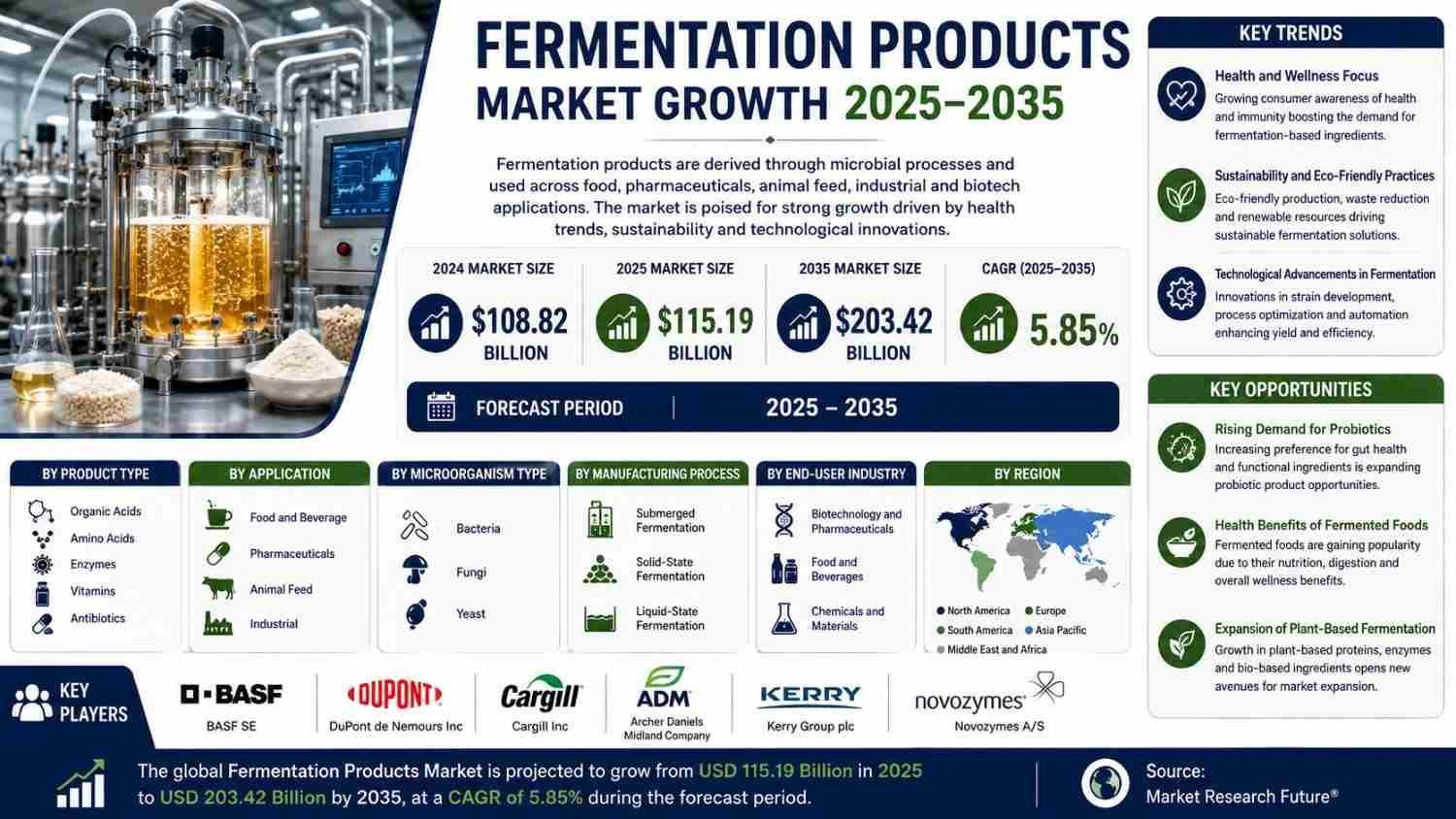
Fermentation is no longer confined to breweries, bakeries, dairy cultures, or traditional food production. It is becoming a broader manufacturing platform for producing ingredients and compounds used across food, pharmaceuticals, animal nutrition and industrial processing. The Fermentation Products Market was valued at USD 108.82 billion in 2024 and reached USD 115.19 billion in 2025. It is projected to reach USD 203.42 billion by 2035, representing a CAGR of 5.85% from 2025 to 2035. The important development behind those numbers is the widening role of fermentation as manufacturers search for scalable ways to produce functional ingredients, enzymes, amino acids, organic acids and other bio-based products.
Why Fermentation Demand Is Broadening
The strongest change in the market is the expansion of applications beyond conventional fermented foods. Manufacturers increasingly need ingredients that can be produced with greater process control and tailored biological characteristics. Fermentation provides a route to producing compounds that can be difficult or resource-intensive to obtain through conventional chemical processes.
Food and beverage companies are one major source of demand. Fermentation supports the production of ingredients associated with flavor, preservation, nutrition and functional food formulations. The growing interest in probiotics and fermented foods also creates a consumer-facing demand layer. However, the industrial significance goes further. Fermentation-derived enzymes can support processing efficiency, while amino acids and vitamins have roles in nutritional formulations and animal feed.
Pharmaceutical applications add another layer of value. Fermentation can be used to manufacture biologically derived compounds and pharmaceutical ingredients under tightly controlled conditions. As biotechnology becomes more integrated with pharmaceutical manufacturing, the ability to manage microorganisms, nutrients, temperature, oxygen and downstream recovery becomes increasingly important.
This diversity makes the market less dependent on a single end-use industry.
The Technology Shift Behind the Market
The central technology story is better control of biological production. Fermentation performance depends on variables such as microorganism selection, nutrient composition, temperature, pH, oxygen transfer and processing time. Improvements in these areas can influence yield, consistency and production economics.
Submerged fermentation remains particularly relevant where manufacturers require controlled liquid environments and scalable production. Solid-state and liquid-state approaches also serve different process requirements, while advances in microbial selection and process monitoring can help manufacturers improve repeatability.
The development of precision fermentation is particularly important to watch. Instead of relying only on naturally occurring fermentation pathways, biotechnology can be used to optimize microorganisms for specific production objectives. That creates possibilities for producing targeted ingredients with more predictable characteristics.
The technology challenge is that laboratory success does not automatically translate into commercial economics. A microorganism may produce an attractive compound under controlled conditions, yet industrial-scale fermentation must also manage energy consumption, feedstock costs, contamination risks and downstream purification.
Where the Demand Is Coming From
Food and beverages remain a major application area because fermentation intersects with several consumer trends simultaneously. Probiotic products, fermented foods, functional ingredients and cleaner formulations can all create demand for fermentation-derived materials.
Pharmaceuticals represent a different opportunity. Here, consistency and quality can be more important than simple production volume. Fermentation-based manufacturing can support the production of specialized compounds, but commercial suppliers must meet demanding quality and process-control expectations.
Animal feed is another important application. Amino acids, enzymes, vitamins and other fermentation-derived ingredients can help formulate feed with targeted nutritional characteristics. As producers seek efficiency across livestock and aquaculture operations, fermentation-derived products can become part of broader feed optimization strategies.
Industrial applications extend the market further. Fermentation can produce enzymes and organic compounds used in chemical processing, materials and other industrial systems. This creates an important distinction: the future of the market is not simply about selling more fermented products, but about replacing or improving individual industrial processes with biological production routes.
Sustainability Has a More Complicated Role
Sustainability is increasingly influencing fermentation investment, but the environmental case depends on the entire production system.
Fermentation can provide bio-based alternatives to some conventional production pathways, potentially reducing dependence on certain fossil-derived inputs. Yet fermentation facilities still consume energy, water and raw materials. Large-scale operations also require downstream separation and purification, which can add significant resource requirements.
Feedstock sourcing is therefore becoming an important consideration. Agricultural inputs, sugars, starches and other biological feedstocks can influence both cost and environmental performance. The industry will need to balance renewable sourcing with land use, water consumption and supply-chain resilience.
The strongest sustainability opportunities are likely to emerge where biological production solves a specific resource problem rather than simply being marketed as a greener alternative.
The Main Commercial Challenges
Scaling remains one of the industry's most difficult problems. Fermentation is sensitive to biological variability, and a process that performs reliably at laboratory scale can behave differently in large reactors.
Contamination is another critical concern because unwanted microorganisms can compromise an entire production batch. Maintaining sterile or controlled operating conditions requires infrastructure, monitoring and disciplined process management.
Raw-material costs also matter. Changes in feedstock prices can influence production economics, especially for high-volume products. Downstream processing can be equally important because recovering and purifying the desired compound may account for a substantial portion of total manufacturing costs.
These factors favor companies that can combine biological expertise with industrial engineering and supply-chain management.
Where the Next Opportunities Are Emerging
The strongest opportunities are appearing where fermentation intersects with high-value applications.
Probiotics remain an important area because consumer interest in digestive health and functional nutrition continues to support product innovation. Plant-based fermentation is another area to watch as food manufacturers explore ways to improve the taste, texture and nutritional profile of alternative proteins and ingredients.
Pharmaceutical and biotechnology applications could create additional value because specialized products can command higher margins than commodity fermentation outputs. Co-developed fermentation processes between ingredient suppliers and downstream manufacturers may also become more common as customers seek customized biological solutions.
Industrial biotechnology offers another avenue. Enzymes and other fermentation-derived products can potentially improve processes that currently depend on energy-intensive or chemically intensive methods.
Regional Demand Will Depend on Industrial Capabilities
The regional market story is shaped by the concentration of food processing, pharmaceutical manufacturing, biotechnology research and agricultural supply chains.
Asia-Pacific has strong potential because of its large food and pharmaceutical manufacturing base and expanding industrial biotechnology capabilities. The region also benefits from large consumer markets and increasing demand for functional foods and nutritional products.
North America remains important because of its biotechnology ecosystem and established pharmaceutical and food industries. Commercialization of advanced fermentation technologies can benefit from the region's combination of research capabilities, capital availability and specialized manufacturing infrastructure.
Europe brings another dimension through its emphasis on sustainable production, food innovation and industrial efficiency. Its regulatory environment can encourage manufacturers to improve process transparency and environmental performance, although compliance can also increase commercialization requirements.
Competition Is Moving Beyond Production Volume
The competitive landscape includes major companies such as BASF, DuPont, Cargill, Archer Daniels Midland Company, Kerry Group and Novonesis.
Their relevance reflects the breadth of the fermentation ecosystem. Some operate across food and ingredients, while others bring biotechnology, enzyme expertise, agricultural integration or industrial-scale processing capabilities. Competition is therefore increasingly about the ability to translate biological innovation into reliable commercial production.
What to Watch Through 2035
Three developments deserve particular attention: precision fermentation, plant-based fermentation and process automation.
Precision fermentation could expand the range of products manufactured biologically. Plant-based fermentation may become increasingly important in food innovation, particularly where manufacturers need to solve flavor, texture or functionality problems. Automation and process analytics could help address the industry's scaling challenge by improving control over biological variables.
The USD 203.42 billion market projection by 2035 reflects more than rising demand for fermented foods. It points toward fermentation becoming a broader manufacturing technology across multiple industries.
Market Outlook
The most important question for the fermentation products industry is not whether fermentation will expand, but where its economics will become compelling enough to replace or complement established production methods. Companies that can improve yield, reduce downstream costs, secure dependable feedstocks and demonstrate consistent quality will have an advantage. The market's next phase will therefore be defined by industrialization: turning biological potential into repeatable, scalable and commercially competitive manufacturing.
Another Trending Topics: Natural Chelating Agent Market | Natural Ferulic Acid Market | Natural Fiber Reinforcement Material Market
 Portuguese (Brazil)
 English
 Arabic
 French
 Spanish
 Portuguese
 Deutsch
 Turkish
 Dutch
Dutch
 Italiano
 Russian
 Romaian
 Greek
Greek
