


Why SOC Audit Beats Internal Reviews in India
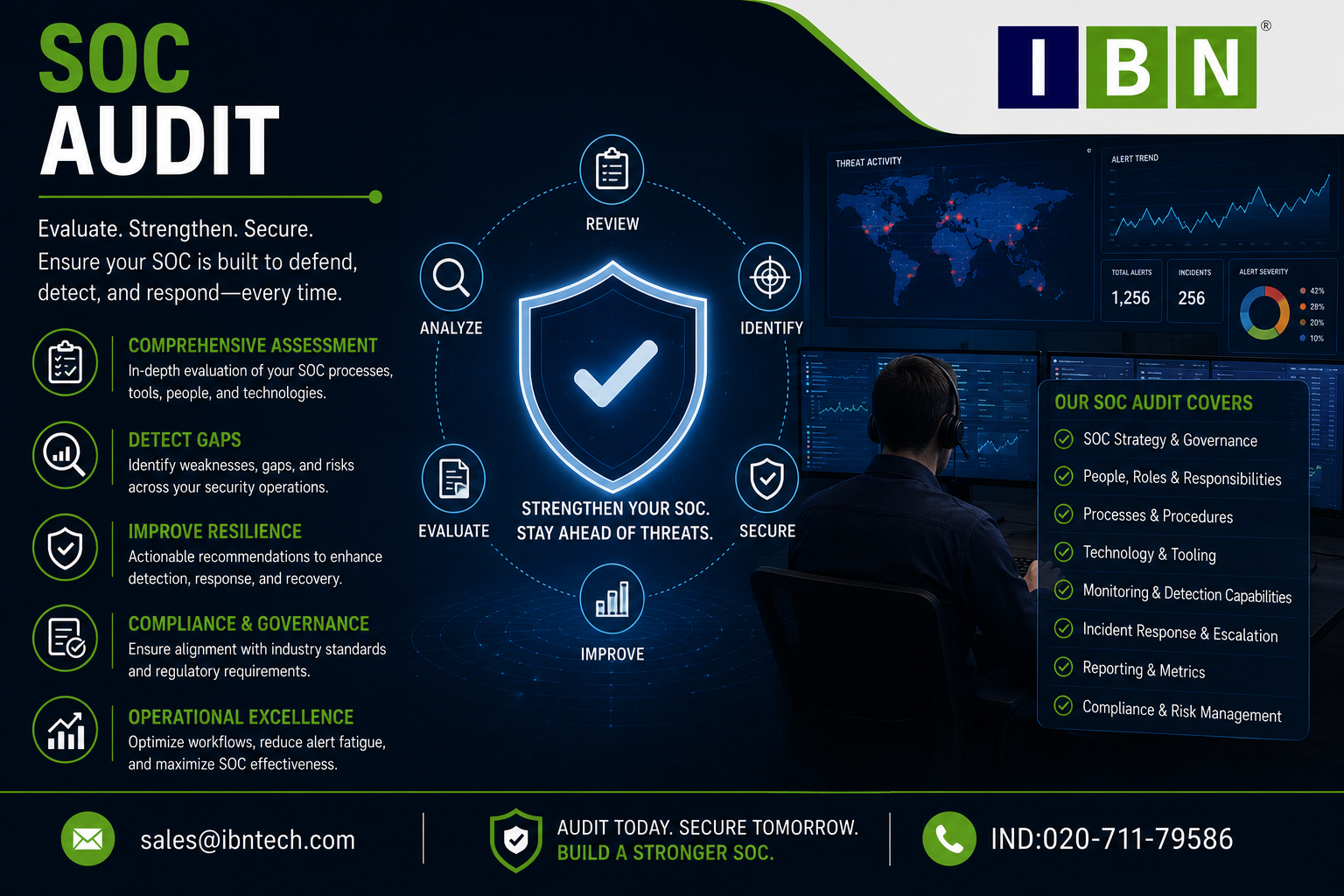
Why SOC Audit Beats Internal Reviews in India
Indian IT companies manage diverse client environments, cloud workloads, development platforms, and distributed workforces. This complexity makes cybersecurity an ongoing operational challenge rather than an occasional IT task. A SOC audit enables organizations to assess whether their Security Operations Center is equipped to identify, investigate, and respond to threats efficiently. While many businesses rely on internal security reviews, these assessments often provide only a limited view of how security operations perform in real-world scenarios.
Why Security Operations Require More Than Internal Reviews
As IT businesses expand, they introduce new applications, cloud services, APIs, and remote access points. Every addition increases the attack surface and generates more security events to monitor.
Internal security reviews usually focus on checking configurations, updating policies, or validating technical controls. Although these activities remain valuable, they rarely evaluate how effectively the Security Operations Center performs during everyday operations.
A SOC audit helps organizations understand whether their security monitoring processes can support business continuity, client trust, and regulatory expectations.
How Internal Reviews Differ from a SOC Audit
Internal reviews are typically conducted by in-house IT or security teams who already manage the organization's infrastructure. Their primary objective is often to verify that systems comply with internal standards.
A SOC audit takes a broader operational approach by evaluating how security monitoring, detection, response, and reporting function together.
SOC Audit vs Internal Security Review
|
Area |
SOC Audit |
Internal Review |
|
Focus |
End-to-end security operations |
Technical controls and configurations |
|
Monitoring Assessment |
Evaluates monitoring effectiveness |
Limited operational review |
|
Incident Response |
Reviews investigation and escalation processes |
Often policy-focused |
|
Alert Quality |
Assesses detection accuracy |
Rarely evaluated in depth |
|
Process Improvement |
Provides operational recommendations |
Usually identifies technical issues |
|
Continuous Security |
Supports long-term operational maturity |
Often periodic and compliance-driven |
This broader perspective enables organizations to identify operational gaps that traditional reviews may overlook.
Where Internal Reviews Often Fall Short
Internal teams possess valuable knowledge about business systems, but they also face daily operational responsibilities that limit the time available for comprehensive assessments.
Common limitations include:
- Reviewing only selected systems
- Limited focus on incident response workflows
- Inconsistent documentation
- Difficulty measuring monitoring performance
- Overlooking alert fatigue
- Limited evaluation of security tool integration
These gaps can affect an organization's ability to respond quickly when cyber threats emerge.
Measuring Operational Readiness
An effective SOC audit examines whether security teams can consistently perform critical activities such as:
- Detecting suspicious events
- Investigating alerts efficiently
- Escalating incidents appropriately
- Coordinating response activities
- Producing meaningful security reports
- Continuously improving monitoring processes
Operational readiness becomes especially important for IT companies delivering managed services or handling sensitive client information.
The Value of Managed SOC Services
Many growing IT organizations supplement internal capabilities with Managed SOC Services to strengthen continuous monitoring and incident response.
These services typically support organizations by:
- Monitoring security events around the clock
- Correlating alerts from multiple systems
- Collecting logs across cloud and on-premises environments
- Supporting incident investigation
- Improving visibility into security operations
- Delivering regular reporting for security teams
A SOC audit helps evaluate whether these services are configured effectively and aligned with business objectives.
Benefits of Conducting Regular SOC Audits
Regular operational assessments provide value that extends beyond compliance requirements.
Improved Threat Detection
Audits identify gaps in monitoring coverage, enabling organizations to detect suspicious activities earlier.
Stronger Incident Response
Reviewing response workflows helps reduce delays and improves coordination among security teams.
Better Visibility Across Hybrid Environments
Organizations gain a comprehensive understanding of how security tools perform across cloud, on-premises, and remote infrastructures.
Increased Operational Efficiency
Audit findings help reduce duplicate alerts, streamline investigations, and improve analyst productivity.
Better Client Confidence
IT service providers that regularly evaluate their security operations demonstrate a proactive approach to protecting customer environments.
IT Industry Use Case
A software development company delivers cloud-based solutions to international clients while supporting a hybrid workforce across multiple locations.
Its internal IT team performs quarterly security reviews and applies security patches regularly. Despite these efforts, leadership remains uncertain whether security monitoring processes can effectively detect sophisticated threats.
A SOC audit identifies several operational improvement opportunities, including:
- Incomplete monitoring of cloud workloads
- Delayed escalation procedures
- Duplicate alerts creating analyst fatigue
- Limited visibility into third-party integrations
- Opportunities to optimize log collection
The organization enhances its security operations by refining monitoring processes, improving response workflows, and strengthening visibility across its digital environment.
Best Practices for Evaluating Security Operations
Organizations should treat SOC audits as part of an ongoing cybersecurity improvement strategy rather than a one-time activity.
A practical checklist includes:
- Review monitoring coverage for all critical assets
- Evaluate incident detection capabilities
- Verify log collection from cloud and on-premises systems
- Assess alert prioritization processes
- Review incident escalation workflows
- Measure reporting effectiveness
- Identify automation opportunities
- Update operational documentation
- Conduct periodic reassessments
- Align security operations with business objectives
Following these practices helps organizations maintain consistent security performance as technology environments evolve.
Compliance Considerations
IT companies frequently support clients across industries with varying security and compliance expectations. Regular SOC audits provide documented evidence that security operations are being evaluated and improved continuously.
These assessments also support internal governance by identifying operational risks before they impact service delivery or customer confidence.
Rather than depending solely on periodic internal reviews, organizations benefit from evaluating the effectiveness of their entire security operation. A well-executed SOC audit provides deeper insight into monitoring, detection, and incident response while complementing the capabilities delivered through Managed SOC Services. This approach enables Indian IT businesses to strengthen cyber resilience, improve operational efficiency, and support long-term business growth.
Contact Us:
IBN Technologies LLC:
E-mail: - sales@ibntech.com

 English
 Arabic
 French
 Spanish
 Portuguese
 Deutsch
 Dutch
Dutch
 Italiano
 Russian
 Romaian
 Portuguese (Brazil)
 Greek
Greek
