


Linear Alkyl Benzene Market Forecast to 2035: Key Growth Drivers and Industry Trends
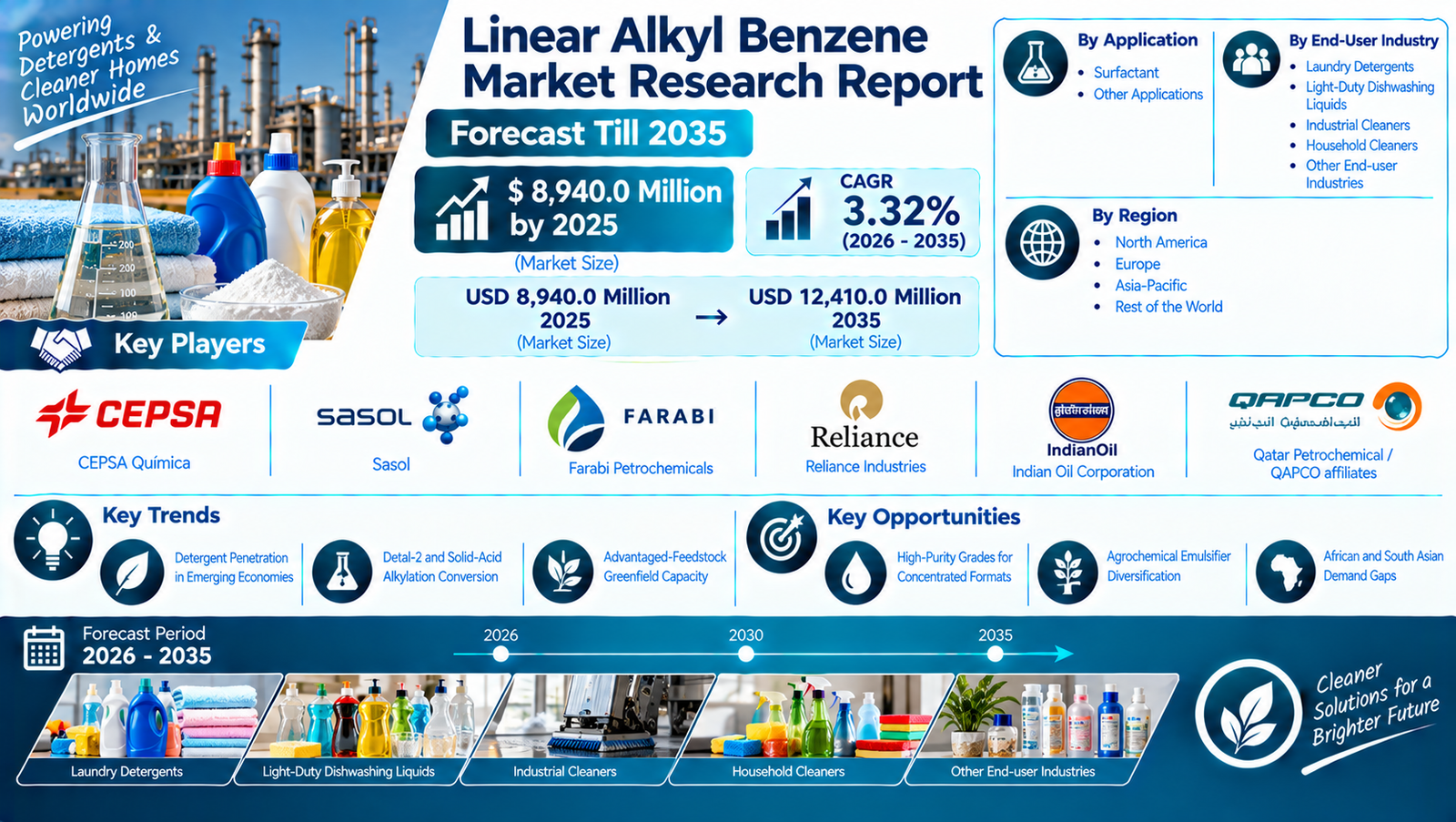
According to Market Research Future® (MRFR), the Linear Alkyl Benzene Market is projected to expand from USD 8,940.0 million in 2025 to USD 12,410.0 million by 2035, registering a compound annual growth rate (CAGR) of 3.32% during the forecast period of 2026–2035. Market development is closely associated with the use of linear alkyl benzene (LAB) in surfactant production, particularly for household and industrial cleaning formulations. Demand from laundry detergents, dishwashing liquids, and other cleaning products continues to shape the industry's commercial outlook.
Market Overview and Growth Outlook
Linear alkyl benzene is an important intermediate used in the manufacture of surfactants, including materials used in detergent formulations. Its relevance to everyday cleaning products gives the market a broad demand base across household and commercial applications. As populations grow, urban lifestyles evolve, and access to packaged cleaning products increases, manufacturers continue to require raw materials that support established surfactant production processes.
The market's projected expansion reflects a combination of recurring demand from mature cleaning applications and opportunities in developing economies. The forecast indicates gradual growth rather than a sudden change in consumption patterns. With the market expected to reach USD 12,410.0 million by 2035, suppliers will need to balance reliable production, competitive feedstock sourcing, product quality, and the evolving requirements of detergent manufacturers.
Application and End-User Demand
Surfactants represent a central application for linear alkyl benzene. They are used in formulations designed to help remove oils, soils, and other residues from surfaces and fabrics. The relationship between LAB and surfactant production links the market to a wide range of cleaning products purchased by households, businesses, and institutions.
Laundry detergents are a significant end-user category because washing products are regularly consumed and replenished. Changes in household formation, product availability, and detergent purchasing habits can influence demand for the ingredients used in these formulations. In emerging economies, increasing detergent penetration creates an opportunity for suppliers to serve a wider consumer base as packaged cleaning products become more accessible.
Light-duty dishwashing liquids and household cleaners provide additional outlets. These products serve everyday cleaning requirements and depend on formulations suited to different surfaces and cleaning tasks. Industrial cleaners also contribute to demand, with requirements shaped by commercial and industrial cleaning activities. Other end-user industries provide further applications, although their individual contribution depends on the specific products and formulations they use.
Key Market Trends
Detergent penetration in emerging economies is an important trend shaping the industry's outlook. Greater availability of branded detergents and broader access to modern retail and distribution channels can support the use of surfactant-based products. For LAB producers, this creates opportunities to supply manufacturers serving consumers whose cleaning-product usage and preferences continue to develop.
Production technology is another area of focus. Detal-2 and solid-acid alkylation conversion are identified as relevant industry trends, highlighting interest in process technologies and production configurations. For manufacturers, conversion decisions can involve operational performance, product specifications, equipment requirements, and the economics of maintaining or upgrading facilities. The suitability of a particular technology depends on plant-specific conditions and commercial objectives.
Advantaged-feedstock greenfield capacity also features in the market outlook. Feedstock economics influence the cost structure of chemical production, making access to competitive inputs an important consideration when planning new capacity. Greenfield investment may provide an opportunity to establish production facilities around selected feedstock and process configurations. However, project feasibility remains dependent on capital requirements, infrastructure, expected demand, and the ability to compete with established suppliers.
Opportunities for Market Participants
High-purity grades for concentrated formats represent one potential growth opportunity. Detergent manufacturers developing concentrated products may require raw materials that meet precise formulation and performance specifications. LAB suppliers that can consistently meet customer quality requirements may be better positioned to support specialized applications. Commercial success will depend on qualification processes, cost competitiveness, and the technical needs of individual customers.
Agrochemical emulsifier diversification offers another avenue for expansion. Emulsifiers help support the formulation and distribution of certain agricultural chemical products. Exploring this application could allow market participants to broaden their customer base beyond conventional cleaning-related demand. The opportunity will depend on formulation suitability, regulatory requirements, customer qualification, and competition from alternative materials.
African and South Asian demand gaps also present potential opportunities. These markets may offer scope for suppliers to serve growing demand where local production, distribution, or supply availability does not fully align with customer needs. Companies evaluating these regions must consider logistics, import requirements, infrastructure, customer relationships, and the economics of serving geographically dispersed buyers. Partnerships with regional distributors or manufacturers may help address some of these challenges.
Competitive Landscape
The market includes CEPSA Química, Sasol, Farabi Petrochemicals, Reliance Industries, Indian Oil Corporation, and Qatar Petrochemical / QAPCO affiliates. These companies form part of the competitive environment in which producers seek to serve detergent and chemical customers. Competition can involve product consistency, dependable deliveries, production efficiency, customer relationships, and the ability to respond to changing specifications.
As demand develops, suppliers will need to evaluate capacity planning and customer requirements alongside feedstock costs and operating performance. Investments in process conversion or new facilities may influence individual companies' cost positions, but outcomes will depend on execution and market conditions.
Market Outlook Through 2035
The Linear Alkyl Benzene Market is expected to maintain a measured growth trajectory through 2035, supported by surfactant demand and the continued use of cleaning products across household and industrial settings. Emerging-economy detergent penetration, production technology developments, and advantaged-feedstock capacity plans will remain important considerations for industry participants. At the same time, opportunities in concentrated formulations, agrochemical emulsifiers, and underserved regional markets could help diversify demand. The projected 3.32% CAGR highlights the value of disciplined investment, efficient production, and close alignment with customer requirements over the forecast period.

 Arabic
 French
 Spanish
 Portuguese
 Deutsch
 Turkish
 Dutch
 Italiano
 Russian
 Romaian
 Portuguese (Brazil)
 Greek
