


Heavy Construction Equipment Market: How Automation and Rental Models Are Reshaping the Industry
Why Heavy Construction Equipment Is Becoming More Intelligent and Flexible
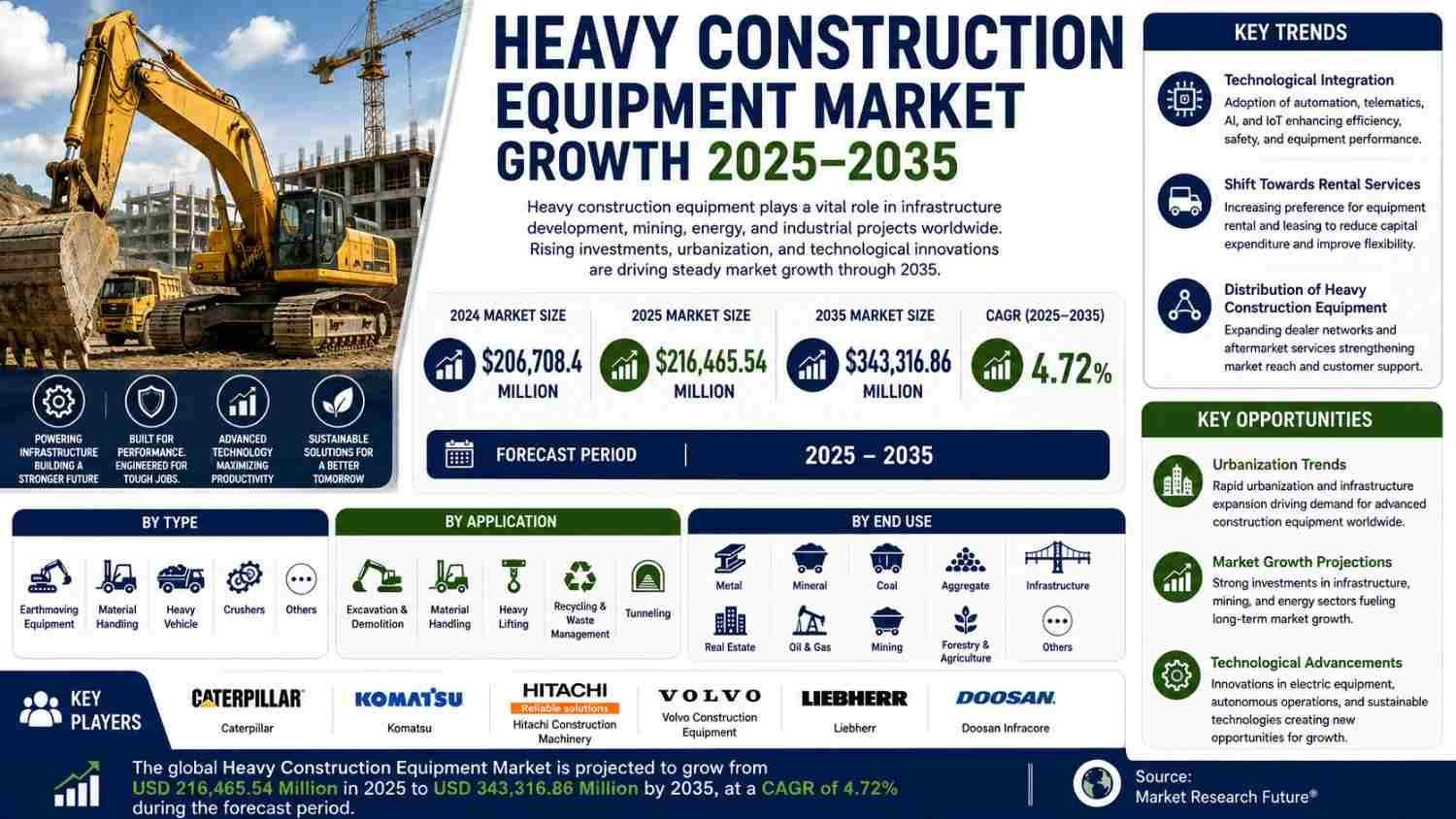
Construction companies are under pressure to move more material, complete projects faster and control operating costs while dealing with increasingly complex infrastructure requirements. The Heavy Construction Equipment Market Growth reflects that shift: the market was valued at USD 206,708.4 million in 2024 and reached USD 216,465.54 million in 2025. It is projected to reach USD 343,316.86 million by 2035, expanding at a CAGR of 4.72% from 2025 to 2035. Urbanization, infrastructure development, technological integration and the growing use of equipment rental models are changing how contractors acquire and operate machinery.
Construction Demand Is Becoming More Equipment Intensive
Heavy equipment is no longer simply a productivity tool on a construction site. It increasingly determines how efficiently a project can be executed.
Large infrastructure projects require excavation, lifting, hauling, crushing, grading and material handling across multiple stages. When project schedules become tighter, contractors have less tolerance for equipment downtime or inefficient fleet utilization.
This is creating demand for machines that can deliver more work per operating hour.
Earthmoving equipment remains essential for excavation and site preparation, while heavy vehicles support transportation of materials and debris. Material-handling equipment becomes particularly important on projects where large quantities of construction inputs must be moved between different work zones.
Crushers and related machinery also serve a growing role where construction and demolition materials are processed for reuse or disposal.
The important shift is that buyers are increasingly evaluating equipment based on productivity, fuel consumption, maintenance requirements and total ownership cost rather than simply machine size.
Urbanization Is Expanding the Equipment Opportunity
Urban development is one of the strongest structural factors supporting demand.
As cities expand, construction activity becomes more diverse. New housing, commercial facilities, transportation networks, utilities and public infrastructure all require heavy machinery.
Urban construction can also be technically difficult.
Projects may operate in confined areas where maneuverability matters, while traffic restrictions and neighboring buildings can limit the available working space.
This creates demand for equipment that combines power with precision.
Contractors increasingly need machines that can perform demanding tasks without creating unnecessary disruption around active urban environments.
The result is a market opportunity for manufacturers that can improve control systems, machine efficiency and operating flexibility.
Infrastructure Projects Create Long-Cycle Demand
Infrastructure development provides another important foundation for the industry.
Roads, bridges, tunnels, ports, rail networks and utility projects require machinery across extended project cycles.
Excavation and demolition equipment supports early-stage work. Heavy lifting machinery becomes important during structural construction, while material-handling equipment supports movement of components and supplies.
Tunneling creates particularly demanding requirements because machinery must operate in environments where access and working conditions can be difficult.
Infrastructure projects therefore tend to reward equipment with high reliability.
A machine failure can affect not only the equipment itself but also labor scheduling, subcontractor coordination and project deadlines.
This makes after-sales support and service availability increasingly important parts of equipment selection.
Technology Is Changing How Fleets Are Managed
Technological integration is one of the most significant developments in heavy construction equipment.
Modern machines can increasingly incorporate sensors, digital controls, telematics and connected fleet-management systems.
The value of these technologies is not simply that they make equipment more sophisticated.
They can provide operators and fleet managers with information that helps them understand machine utilization, maintenance needs and operating conditions.
For contractors with large fleets, better visibility can reduce unnecessary idle time and improve scheduling.
Predictive maintenance can also help shift maintenance decisions from reactive repairs toward planned interventions.
That can be commercially important because the cost of equipment downtime can extend beyond the repair itself.
Automation Is Moving From the Factory to the Job Site
Automation is also beginning to influence construction machinery.
Machine-control systems can improve precision in excavation and grading, reducing dependence on repeated manual measurements.
More advanced automation can support semi-autonomous operations in controlled environments.
The adoption path will not be identical across every application.
Fully autonomous operation remains more complicated on dynamic construction sites, where workers, vehicles and changing terrain interact continuously.
Semi-automated functions may therefore become more practical in the near term.
The business case is strongest where automation can improve consistency, reduce operator workload or increase safety without requiring contractors to completely redesign their operations.
Rental Services Are Changing Equipment Ownership
The growth of rental services represents another important structural shift.
Heavy equipment can require substantial capital investment, and utilization rates can vary significantly between projects.
Owning a machine that remains idle for long periods can weaken fleet economics.
Rental models allow contractors to match equipment access more closely with project requirements.
This can be particularly useful for smaller construction companies that cannot justify purchasing every specialized machine they occasionally need.
Rental also gives contractors flexibility when project types change.
For manufacturers, this creates a different customer relationship. Equipment may increasingly be selected by rental companies based on durability, utilization potential, serviceability and residual value.
Equipment Distribution Is Becoming More Important
The market's distribution structure influences how quickly contractors can access new machinery and replacement parts.
Heavy construction equipment cannot always be treated like a standard industrial product that can be shipped without local support.
Customers need maintenance, parts, technical assistance and operator training.
Manufacturers with established dealer networks therefore have an advantage when entering or expanding in new markets.
Distribution is also becoming more data driven.
Connected equipment can help manufacturers and dealers understand how machines are being used and when service may be required.
That can strengthen relationships with customers while creating opportunities for more proactive service models.
Sustainability Is Becoming an Equipment Design Issue
Environmental pressure is changing expectations around construction machinery.
Fuel consumption remains a major operating consideration, particularly for equipment that works for long hours under heavy loads.
Manufacturers are therefore exploring ways to improve engine efficiency, machine controls and powertrain technologies.
The transition toward lower-emission equipment is not equally straightforward across every machine category.
Heavy equipment often operates in demanding environments where high power output and long operating periods are essential.
Electrification can be attractive for selected applications, particularly where charging infrastructure is practical, but it may be more difficult for machines operating continuously in remote locations.
This means the industry's sustainability transition is likely to involve several technologies rather than one universal solution.
The End-Use Base Is Broadening the Market
Heavy construction equipment serves more than traditional building projects.
Mining operations require machines capable of handling large volumes of material under severe conditions.
Oil and gas projects can require heavy lifting, transportation and site-development capabilities.
Forestry and agriculture also create demand for specialized machinery.
Metal, mineral and aggregate operations rely heavily on equipment for extraction, processing and transportation.
This diversification helps reduce dependence on any single construction segment.
It also means equipment manufacturers need to understand different operating environments and customer requirements.
A machine designed for urban construction may have very different priorities from equipment used in mining.
Regional Markets Develop Differently
Regional demand is influenced heavily by construction activity, infrastructure investment and industrial development.
Asia-Pacific represents an important growth environment because urban expansion and infrastructure development can create sustained requirements for heavy machinery.
North America benefits from a mature construction ecosystem and demand for equipment replacement, infrastructure work and technology upgrades.
Europe has strong requirements around efficiency, emissions and equipment modernization, making technology an important competitive factor.
Other regions can present opportunities where infrastructure development, resource extraction and urbanization increase machinery requirements.
The key difference between regions is not simply the volume of construction.
It is the type of construction being undertaken and the level of equipment modernization already present in the market.
Major Manufacturers Are Competing on More Than Machine Size
The competitive landscape includes Caterpillar, Komatsu, Hitachi Construction Machinery, Volvo Construction Equipment, Liebherr and Doosan Infracore.
These manufacturers operate across major equipment categories and compete through combinations of product breadth, engineering capabilities, dealer networks and technology integration.
The competitive focus is increasingly moving toward fleet productivity.
Customers want equipment that can remain operational, generate useful data and integrate into increasingly digital construction workflows.
This favors manufacturers that can combine machinery expertise with software, connectivity and service capabilities.
Where the Next Opportunities Are Emerging
Urban construction will remain an important source of demand, but the strongest opportunities may come from the combination of machinery and digital services.
Connected fleet-management platforms can create value beyond the initial equipment sale.
Rental markets offer another opportunity because changing ownership patterns can increase equipment utilization.
Automation is likely to become more important as contractors face productivity and labor challenges.
Equipment designed for recycling and waste management could also gain relevance as construction projects place greater emphasis on material recovery.
What Could Hold the Market Back
Heavy construction equipment remains capital intensive.
High acquisition costs can make contractors cautious, particularly when construction activity is uncertain.
Financing conditions can influence equipment purchases, while supply-chain disruptions can affect machine availability and replacement parts.
Technology can introduce another barrier.
Connected and automated machinery may require training and changes to existing workflows.
Contractors may also hesitate to invest in new systems if the productivity improvement is difficult to quantify.
Manufacturers therefore need to demonstrate practical operating benefits rather than relying on technology as a selling point by itself.
What to Watch Through 2035
The market's development will be shaped by three interconnected changes: more complex construction requirements, greater equipment intelligence and changing ownership models.
Urbanization should sustain machinery demand.
Infrastructure projects should provide long-duration applications.
Rental services can make access to expensive equipment more flexible.
Digital systems can improve fleet utilization and maintenance.
Sustainability requirements will increasingly influence equipment design and purchasing decisions.
The most significant shift may be the movement from equipment as a standalone asset toward equipment as part of a connected project-management ecosystem.
Market Outlook
The forecast increase from USD 216,465.54 million in 2025 to USD 343,316.86 million by 2035 suggests a steady expansion rather than a market driven by a single short-term construction cycle.
The deeper change is taking place in how equipment creates value.
Contractors are increasingly concerned with machine utilization, uptime, precision, maintenance and operating efficiency. Rental providers are focused on durability and asset productivity. Manufacturers are responding by combining heavy machinery with connectivity, automation and service capabilities.
That means the next phase of competition will not be determined only by who builds the largest or most powerful machine. It will increasingly depend on who can help construction companies get more productive work from every hour a machine operates.
Another Trending Topics
 Italiano
 English
 Arabic
 French
 Spanish
 Portuguese
 Deutsch
 Turkish
 Dutch
Dutch
 Russian
 Romaian
 Portuguese (Brazil)
 Greek
Greek
