


India Bunker Fuel Market: How Shipping Growth and Fuel Regulations Are Reshaping Marine Energy Demand
India’s Maritime Expansion Is Changing the Bunker Fuel Equation
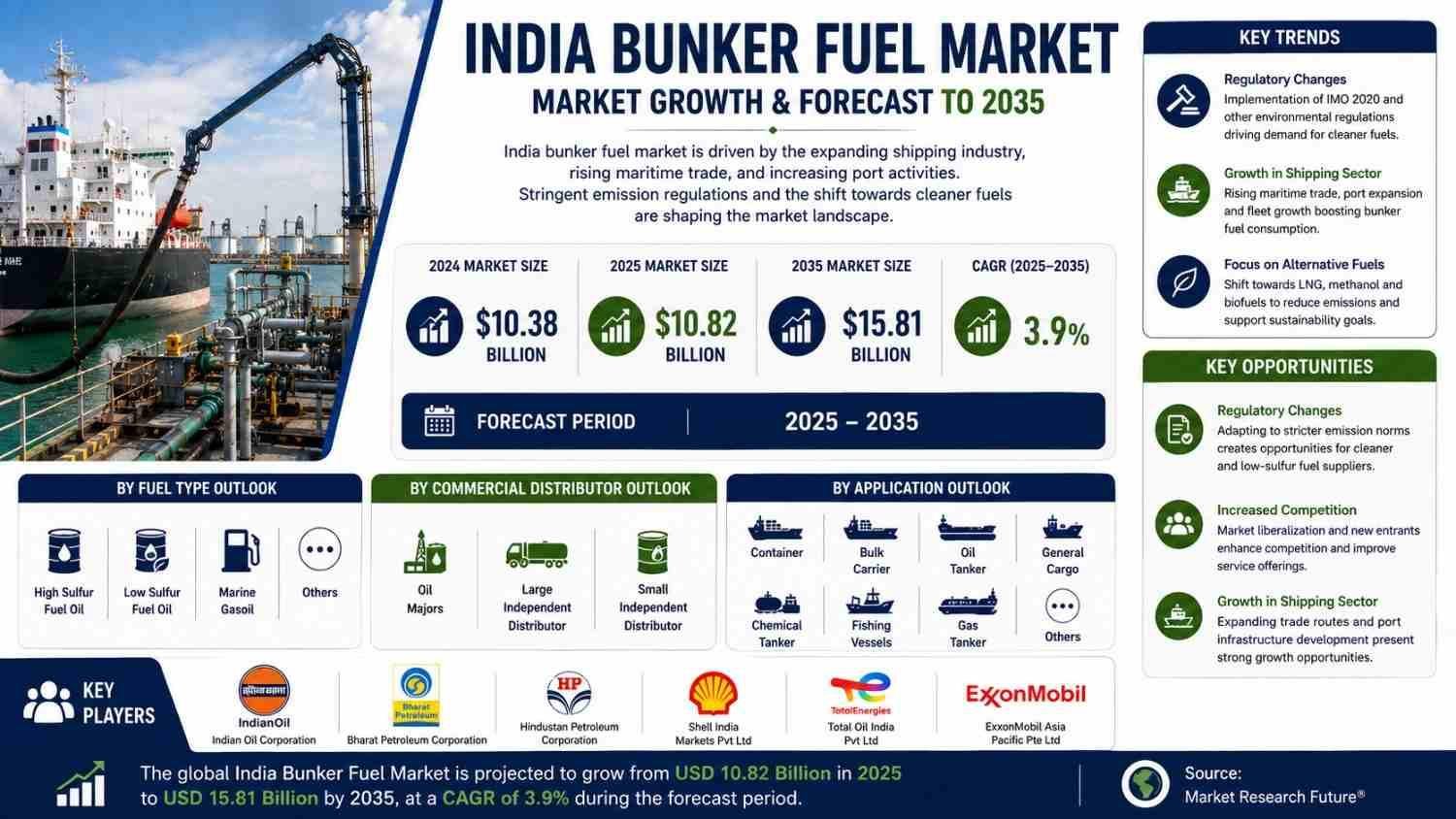
Ships cannot move more cargo without consuming more energy, but the type of energy used at sea is becoming increasingly important. That tension is shaping the India Bunker Fuel Market, which was valued at USD 10.38 billion in 2024 and reached USD 10.82 billion in 2025. The market is projected to reach USD 15.81 billion by 2035, advancing at a CAGR of 3.9% during 2025–2035. The underlying opportunity is being created by the expansion of shipping activity, while regulatory changes and interest in alternative fuels are forcing suppliers and vessel operators to rethink the traditional marine-fuel model.
Why Marine Fuel Demand Remains Closely Tied to Trade
Bunker fuel is fundamentally a logistics input. Container ships need it to move manufactured goods, bulk carriers depend on it for commodities, tankers transport energy and chemicals, and general-cargo vessels connect smaller trade routes.
This makes bunker demand sensitive to maritime activity.
As India's role in manufacturing, trade and port-linked logistics expands, shipping becomes an increasingly important part of the country's industrial infrastructure. More vessel movements create additional requirements for marine fuels, bunkering services and distribution networks.
The important commercial point is that bunker fuel demand does not develop independently. It follows the movement of cargo.
Container shipping represents one important demand channel because higher trade volumes translate into greater vessel utilization. Bulk carriers and tankers create different demand patterns based on commodity movements, while fishing vessels and specialized ships add smaller but diverse consumption pools.
The market therefore benefits from a broad maritime base rather than dependence on a single vessel category.
The Fuel Mix Is Becoming More Complicated
The traditional marine-fuel market is being reshaped by differences between high-sulfur fuel oil, low-sulfur fuel oil and marine gasoil.
Fuel selection is no longer determined only by price and availability. Vessel operators must consider operating requirements, applicable environmental standards and the economics of compliance.
Low-sulfur products can become more attractive when regulatory requirements place greater emphasis on emissions. Marine gasoil provides another fuel option for operators that require or prefer a cleaner-burning marine fuel.
This transition creates a more complicated supply environment.
Distributors need to maintain access to different fuel grades while ensuring that products are available at the locations and times required by vessels. Ship operators, meanwhile, must weigh fuel cost against compliance and operational considerations.
The result is a market where logistics capability can be almost as important as the fuel itself.
Regulation Is Changing the Economics of Bunkering
Regulatory change is one of the most important forces influencing the industry's future.
Environmental standards can increase the cost of using higher-emission fuels or encourage vessel operators to adopt cleaner alternatives. For suppliers, this creates pressure to adapt product portfolios and infrastructure.
For shipowners, the issue is more complicated. Changing fuel can involve procurement adjustments, equipment considerations and operational planning.
This means regulation can affect the market through several channels at once.
It can shift demand from one fuel grade to another, alter pricing relationships and increase interest in alternative marine-energy technologies. The transition is therefore not simply about replacing one product with another. It is about changing how maritime energy is purchased, distributed and consumed.
Shipping Growth Creates Opportunities Across Vessel Categories
India's bunker-fuel opportunity extends across multiple applications.
Container vessels are particularly important because they support international trade in manufactured and consumer goods. Bulk carriers serve industries dependent on commodities and raw materials. Oil and chemical tankers create demand linked to energy and industrial supply chains.
Gas tankers represent another specialized segment where fuel requirements can differ from conventional cargo vessels.
Fishing vessels and general-cargo ships broaden the market further, especially where regional maritime activity creates recurring fuel demand.
This diversity matters because different vessel types respond differently to fuel prices, regulations and operational requirements.
A supplier serving only one vessel category may face greater exposure to fluctuations in a particular trade lane. Companies with broader distribution capabilities can potentially serve a wider range of marine customers.
The Distribution Network Is a Competitive Asset
The commercial distributor structure includes oil majors, large independent distributors and smaller independent distributors.
This creates competition around more than fuel pricing.
Bunker fuel must be available when vessels need it. Delays can affect schedules, port operations and cargo movements. Reliability of supply can therefore become an important factor in customer decisions.
Large suppliers can benefit from established infrastructure, procurement capabilities and broad market reach. Independent distributors may compete through flexibility, local relationships or specialized service.
The balance between these models can change as maritime customers seek both competitive pricing and dependable access to compliant fuel grades.
Technology Is Supporting Better Fuel Management
The next stage of the bunker-fuel market is likely to involve greater use of operational data.
Vessel operators increasingly have reasons to monitor fuel consumption, voyage efficiency and procurement costs more closely. Better visibility can help identify inefficiencies and improve fuel planning.
For suppliers, digital systems can support inventory management, order coordination and customer relationships.
The value of these technologies is practical. Marine fuel is expensive, and relatively small improvements in consumption or purchasing efficiency can influence voyage economics.
Digitalization can therefore complement rather than replace the physical bunker-fuel network.
The Alternative-Fuel Question Is Growing
The market's long-term direction cannot be separated from the search for alternative marine fuels.
Shipping companies face pressure to reduce emissions while maintaining commercially viable operations. This has increased attention toward cleaner fuel pathways and alternative propulsion technologies.
However, the transition is unlikely to happen uniformly.
Existing vessels have long operating lives, while ports and suppliers require infrastructure before alternative fuels can be distributed at scale. Conventional bunker fuels can therefore remain important even as new options emerge.
This creates a transitional market rather than an immediate replacement scenario.
Fuel suppliers that understand this transition can potentially position themselves around both today's demand and tomorrow's marine-energy requirements.
Sustainability Creates Both Pressure and Opportunity
The sustainability challenge extends beyond fuel selection.
Marine fuel production, transportation and consumption all carry environmental implications. Cleaner fuel alternatives can reduce certain emissions, but their overall impact depends on production methods, supply chains and lifecycle characteristics.
The industry therefore needs to evaluate sustainability beyond the label attached to a particular fuel.
For Indian suppliers, this creates an opportunity to participate in the gradual modernization of marine-energy infrastructure. But investment decisions need to account for uncertain demand, infrastructure costs and the pace at which vessel operators change technologies.
Regional Market Insights
India's maritime geography gives bunker fuel a distinctive strategic role.
Ports connect domestic industrial centers with international shipping routes, while coastal activity supports movement of commodities and goods within the country.
The strongest opportunities are likely to emerge around locations where vessel traffic, industrial activity and fuel infrastructure intersect.
Port development can strengthen this relationship by increasing the capacity of maritime logistics networks. However, regional demand will not necessarily develop at the same pace.
Locations serving major trade corridors can have different fuel requirements from ports primarily supporting coastal or specialized shipping activity.
Competitive Landscape
The competitive environment includes Indian Oil Corporation, Bharat Petroleum Corporation, Hindustan Petroleum Corporation, Shell India Markets Pvt Ltd, Total Oil India Pvt Ltd and ExxonMobil Asia Pacific Pte Ltd.
These companies represent different strengths across fuel supply, distribution and international energy networks.
Indian public-sector oil companies have an established presence in India's broader fuel infrastructure, while international energy companies bring global supply expertise and experience across marine-energy markets.
Competition will increasingly depend on the ability to provide appropriate fuel grades reliably, manage changing regulatory requirements and support customers during the transition toward cleaner marine energy.
What to Watch Through 2035
The market's development will be shaped by three interconnected questions.
First, how quickly will maritime trade and vessel activity expand? Second, how will environmental regulation alter the relative economics of different bunker fuels? Third, how quickly will alternative marine fuels move from selective adoption to wider commercial use?
The answers will determine where investment flows.
Suppliers may need to balance continued demand for conventional products with infrastructure and capabilities for newer fuels. Vessel operators will similarly need to manage the economics of existing fleets while preparing for changing energy requirements.
Market Outlook
India's bunker fuel market is projected to rise from USD 10.82 billion in 2025 to USD 15.81 billion by 2035, but the industry's most important change may be qualitative rather than numerical.
Bunker fuel is moving from being treated primarily as a commodity purchase toward becoming a strategic component of maritime efficiency and regulatory compliance.
That shift gives suppliers with reliable distribution, flexible fuel portfolios and strong customer relationships an advantage. It also means the market's future will depend not only on how many ships India serves, but on how effectively its marine-fuel infrastructure adapts to a shipping industry that is becoming more regulated, more data-driven and gradually less dependent on conventional fuels.
Another Trending Topics
 Spanish
 English
 Arabic
 French
 Portuguese
 Deutsch
 Turkish
 Dutch
Dutch
 Italiano
 Russian
 Romaian
 Portuguese (Brazil)
 Greek
Greek
