


B2B Courier Express Parcel Market: How Faster Business Delivery Is Reshaping Global Commerce
B2B Delivery Is Becoming a Competitive Business Function
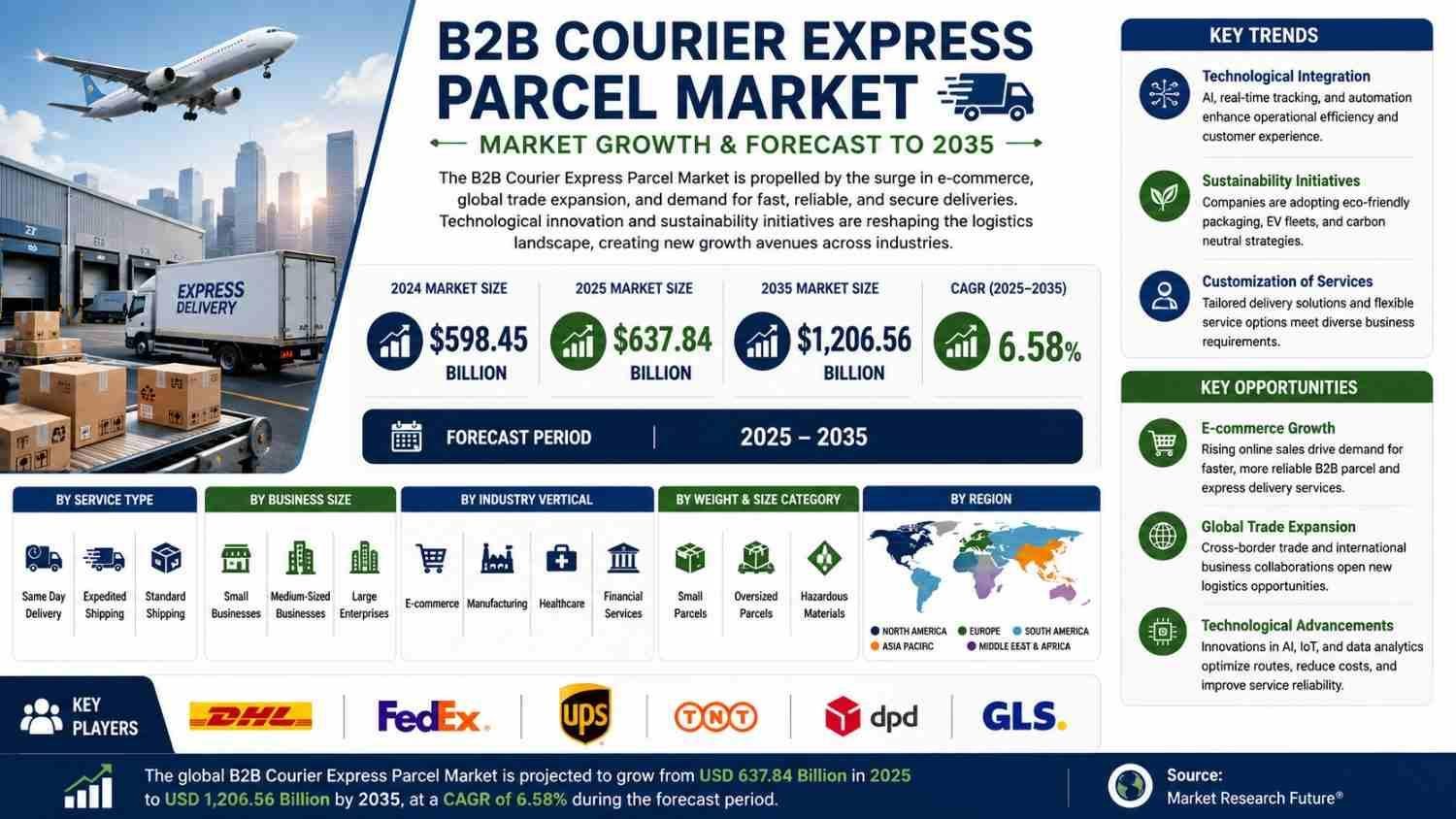
A delayed shipment can interrupt production, leave a retailer without inventory, or prevent a service provider from meeting a customer commitment. That makes business parcel delivery far more than a transportation activity. The B2B Courier Express Parcel Market was valued at USD 598.45 billion in 2024 and reached USD 637.84 billion in 2025. It is projected to reach USD 1,206.56 billion by 2035, representing a CAGR of 6.58% from 2025 to 2035. Behind those figures is a structural change in how companies manage inventory, suppliers, customers, and time-sensitive operations.
Business buyers increasingly expect logistics providers to deliver the same visibility and flexibility that consumers have become accustomed to in online shopping. The difference is that B2B shipments can involve heavier parcels, specialized handling, scheduled deliveries, cross-border documentation, and consequences that extend well beyond a single order.
Why Speed Has Become an Operational Requirement
B2B delivery demand is being reshaped by shorter production cycles and tighter inventory strategies. Manufacturers are increasingly reluctant to hold excessive inventory simply to protect against supply disruptions. Instead, faster replenishment can allow businesses to operate with more responsive inventories.
This creates demand for several service models. Same-day delivery is valuable when a production line needs a replacement component. Expedited shipping becomes important when a distributor must replenish a fast-moving product. Standard shipping remains essential for predictable, lower-cost flows, while freight services address larger or heavier consignments.
E-commerce is adding another layer. Businesses purchasing components, maintenance supplies, packaging materials, office equipment, and other products online are generating a more fragmented shipment profile. Instead of a small number of large transactions, suppliers increasingly manage numerous deliveries to different business locations.
For courier operators, the commercial challenge is therefore not simply moving more parcels. It is managing greater complexity without allowing service costs to rise at the same pace.
Digital Logistics Is Changing How Parcels Move
Technology is becoming central to that equation. Automated sorting systems can process large volumes of shipments with less manual intervention, while digital tracking platforms provide businesses with information about shipment status and estimated arrival times.
The importance of visibility is particularly high in B2B logistics because a delivery can influence another business process. A shipment containing production inputs, spare parts, medical supplies, or commercial inventory has an operational context that needs to be understood.
Data platforms can connect transportation information with warehouse and order-management systems. That creates opportunities for businesses to identify recurring delays, improve delivery scheduling, consolidate shipments, and adjust inventory decisions.
The next stage is likely to involve deeper use of predictive analytics and automated decision-making. Instead of simply reporting where a parcel is, logistics systems can increasingly help determine where capacity should be allocated, which route is likely to encounter disruption, and when a shipment should be dispatched.
Applications Are Becoming More Diverse
The market serves businesses with very different logistical requirements. E-commerce companies need rapid fulfillment and reliable last-mile performance. Manufacturers require predictable movement of components, finished goods, and replacement parts. Healthcare organizations may depend on tightly controlled delivery schedules for critical products. Financial services and other professional industries generate document and equipment flows that place greater emphasis on security and reliability.
Business size also changes the logistics equation. Small enterprises may outsource most transportation activities because building an internal delivery network is economically difficult. Large enterprises can negotiate volume-based arrangements and require sophisticated integration with their enterprise systems. Medium-sized companies sit between those models and often seek flexible services that can scale with demand.
Shipment size and handling requirements further influence the service model. Small parcels can move through highly automated networks, while oversized shipments require different transportation and handling capabilities. Hazardous materials introduce additional operational complexity because packaging, documentation, routing, and carrier capabilities must meet applicable requirements.
The Economics Behind the Delivery Race
Speed has a cost. Same-day and expedited services require additional transportation capacity, tighter scheduling, and often more complex last-mile operations. If demand becomes too fragmented, vehicles can travel with inefficient loads, increasing the cost per shipment.
This is why route optimization, parcel consolidation, automated sorting, and network density matter commercially. A logistics provider that can increase the number of shipments handled per route or facility can improve utilization without simply adding vehicles and warehouses.
Fuel costs, labor availability, infrastructure quality, and cross-border procedures also influence the economics. International B2B shipments can face customs delays and documentation requirements that have little relationship to the physical distance traveled.
The strongest logistics models will therefore balance speed against network efficiency. Businesses do not necessarily need every shipment delivered immediately; they need the appropriate service level for the value and urgency of each shipment.
Sustainability Is Becoming Part of the Logistics Equation
The environmental challenge is becoming harder to separate from logistics economics. More deliveries can mean more vehicles, packaging materials, fuel consumption, and emissions.
That is creating interest in route optimization, shipment consolidation, alternative-fuel vehicles, electric delivery fleets, reusable packaging, and more efficient distribution networks. Sustainability, however, cannot be treated as a simple vehicle-replacement exercise.
A poorly utilized electric delivery fleet can still be inefficient. Similarly, unnecessary expedited shipments can increase the environmental burden even when the transportation equipment itself becomes cleaner.
The practical opportunity lies in designing networks that reduce unnecessary movement while preserving service reliability. Better demand forecasting and digital visibility can contribute as much to efficiency as changes in vehicle technology.
Regional Growth Will Depend on Network Maturity
North America and Europe benefit from mature parcel networks, established e-commerce ecosystems, and sophisticated business logistics infrastructure. These markets are likely to place greater emphasis on automation, service customization, sustainability, and digital integration.
Asia-Pacific presents a different growth profile. Expanding e-commerce, manufacturing activity, urbanization, and cross-border trade are creating additional demand for business logistics capacity. Network expansion and technology adoption can therefore occur simultaneously.
Emerging markets also offer opportunities for logistics providers willing to build distribution infrastructure around growing commercial centers. However, differences in roads, customs systems, warehouse availability, and digital connectivity can make market expansion uneven.
Competitive Positioning Is Moving Beyond Parcel Transport
DHL, FedEx, UPS, TNT, DPD, and GLS operate in an environment where scale alone is not enough. Large networks provide an important foundation, but business customers increasingly value tracking, integration, flexible service levels, international reach, and dependable delivery performance.
The competitive distinction is therefore shifting toward the ability to combine physical infrastructure with digital capabilities. Providers that can connect shipment visibility with customer systems can become embedded in business operations rather than functioning only as transportation vendors.
Customization is another important differentiator. A small online merchant may need flexible scheduled pickups, while a global manufacturer may require integrated transportation management and cross-border support.
What Could Create the Next Wave of Opportunity
The strongest opportunities are likely to emerge where logistics providers solve specific operational problems. E-commerce expansion will continue to generate parcel volumes, while global trade will require more sophisticated international networks.
Technology can create another opportunity by turning logistics data into a management resource. Shipment information can reveal bottlenecks, recurring delivery failures, inefficient routes, and changing customer behavior.
Sustainability will also create demand for redesigned delivery networks rather than simply cleaner transportation equipment. Companies that can reduce unnecessary miles while maintaining service quality may gain both environmental and economic advantages.
What to Watch Through 2035
The most important development will be the continued convergence of logistics, technology, and business operations. Delivery networks are becoming information networks as much as transportation systems.
Autonomous and increasingly automated logistics technologies could eventually alter the economics of specific routes, while predictive platforms may improve planning before a shipment even enters the network. At the same time, businesses will continue to demand greater flexibility as supply chains become less linear.
Market Outlook
The projected expansion from USD 637.84 billion in 2025 to USD 1,206.56 billion by 2035 signals more than rising parcel volumes. It reflects the increasing economic value of dependable business delivery.
The next decade will favor logistics providers that can make speed economically sustainable, visibility actionable, and delivery networks flexible enough to serve very different customers. For B2B commerce, the winning logistics model will not simply be the fastest one. It will be the network that delivers the right shipment, through the right channel, at the right cost and with enough visibility for the customer to make better business decisions.
Another Trending Topics
Pollution Absorbing Bricks Market | Poloxamer Market | Poly Coated Paper Market
 Spanish
 English
 Arabic
 French
 Portuguese
 Deutsch
 Turkish
 Dutch
Dutch
 Italiano
 Russian
 Romaian
 Portuguese (Brazil)
 Greek
Greek
