


Port Services Market: How Digital Terminals and Global Trade Are Reshaping Maritime Infrastructure
Why Ports Are Becoming Strategic Technology Infrastructure
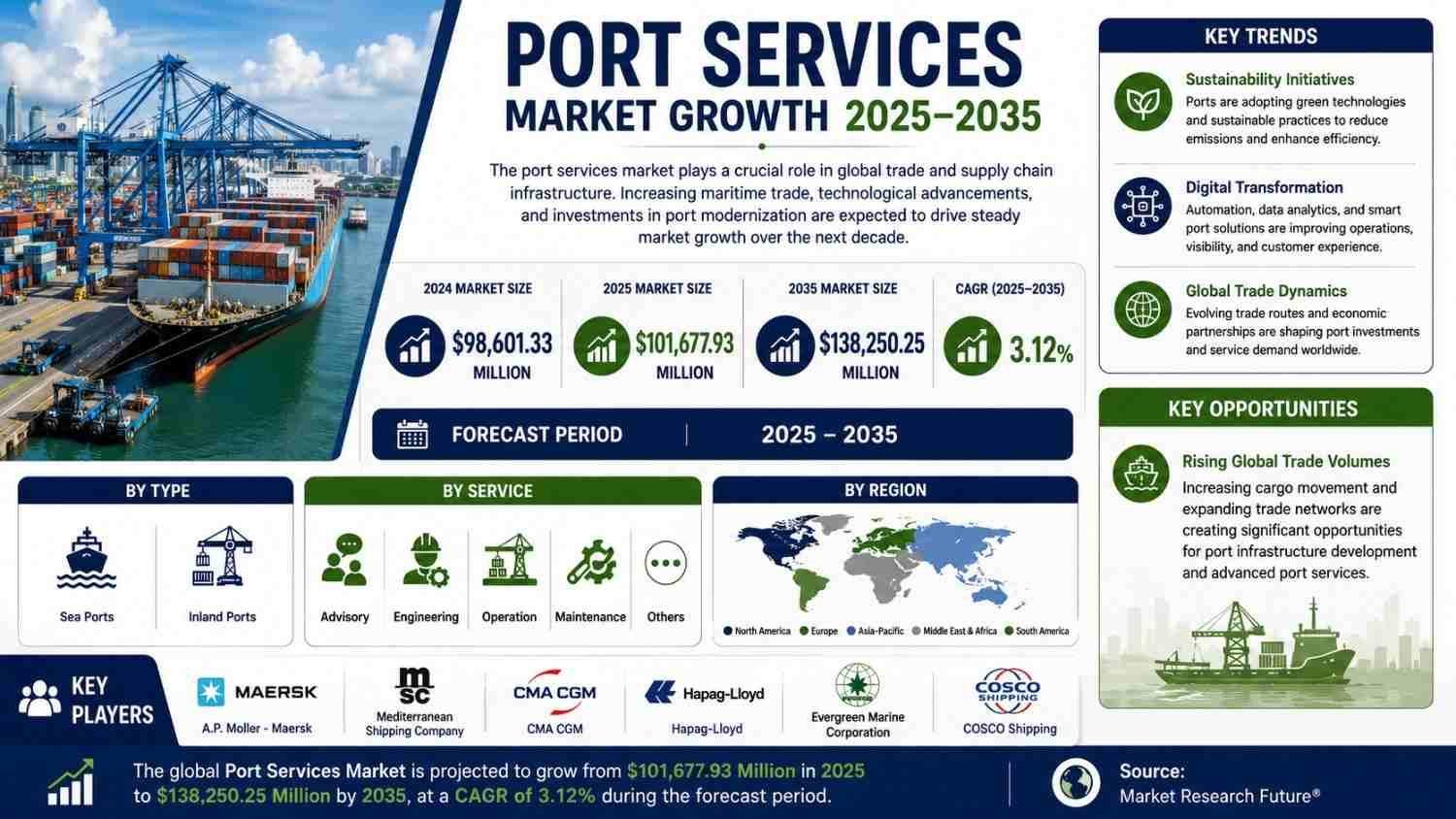
A modern port is no longer simply a place where ships load and unload cargo. It is an operating system for international trade, connecting vessels with warehouses, roads, rail networks, customs processes and inland distribution centers. The Port Services Market was valued at approximately USD 98.60 billion in 2024 and reached USD 101.68 billion in 2025. It is projected to reach USD 138.25 billion by 2035, representing a CAGR of 3.12% during 2025–2035. The underlying shift is less about adding more physical infrastructure and more about making existing trade gateways faster, safer, more connected and more resilient.
Why Global Trade Is Increasing the Pressure on Port Operations
Every increase in international cargo movement places additional demands on port infrastructure. Containers must be received, inspected, stored, moved and transferred with minimal delays. Ships need reliable berthing and cargo-handling services, while inland connections must move goods away from terminals before congestion develops.
That makes port services closely connected to the efficiency of the wider supply chain. A port can have substantial berth capacity yet still create bottlenecks if cranes, storage yards, maintenance systems or inland connections cannot keep pace.
The growth opportunity therefore extends beyond the construction of new terminals. Advisory, engineering, operations and maintenance services are becoming increasingly important because port operators need to extract more productivity from existing assets.
Global trade patterns are also changing. Manufacturing networks are becoming more geographically distributed, while emerging economies are expanding their participation in international commerce. Ports must accommodate changing vessel patterns, cargo mixes and logistics routes rather than relying on historical operating models.
Digitalization Is Moving From the Control Room to the Entire Port
Digital transformation is one of the most important structural changes affecting port services. Modern terminals increasingly depend on connected systems to coordinate vessel arrivals, yard movements, equipment utilization and cargo flows.
The commercial value of this technology is straightforward: better information can reduce idle time. If operators know when vessels are arriving, which containers need to move and where equipment is available, they can coordinate resources more effectively.
Automation is also changing the role of port equipment. Automated and remotely controlled systems can support repetitive cargo-handling activities while improving operational consistency. Digital monitoring can help identify equipment problems before they become major disruptions, making maintenance more predictive rather than purely reactive.
The opportunity is particularly significant for large ports handling complex traffic volumes. However, digitalization is not simply a software investment. It requires reliable communications infrastructure, cybersecurity, trained personnel and compatibility between systems supplied by different technology vendors.
Sea Ports and Inland Ports Serve Different Strategic Needs
The market spans sea and inland ports, but their commercial roles differ.
Sea ports are the primary interface between maritime shipping and global trade routes. Their performance depends heavily on vessel traffic, berth utilization, cargo-handling capacity and connections to inland distribution networks.
Inland ports, meanwhile, extend the logistics reach of maritime gateways. They can support cargo consolidation, storage and intermodal transfers away from congested coastal terminals. As supply chains become more complex, inland facilities can help distribute cargo closer to manufacturing and consumption centers.
This creates a broader opportunity for integrated port-service providers. The value increasingly comes from coordinating the movement of cargo across several stages rather than optimizing a single terminal activity.
Engineering and Maintenance Are Becoming Competitive Differentiators
Port infrastructure operates under demanding conditions. Heavy equipment, saltwater exposure, continuous cargo movement and high utilization create constant maintenance requirements.
Engineering services therefore influence more than asset longevity. Poorly maintained equipment can interrupt vessel schedules, reduce terminal productivity and create knock-on effects across supply chains.
Maintenance strategies are consequently moving toward condition monitoring and predictive approaches where appropriate. Sensors and digital inspection systems can provide information about equipment performance and identify potential failures earlier.
For service providers, this changes the basis of competition. Technical capability, data management and lifecycle support can become as important as the ability to perform conventional engineering work.
Sustainability Is Becoming an Operational Question
Environmental pressure is also reshaping port services. Ports consume substantial energy through cranes, cargo-handling equipment, lighting, buildings and transport systems. Their location at the intersection of maritime and land-based transportation also makes emissions management increasingly important.
Sustainability initiatives therefore extend beyond installing cleaner equipment. Operators must consider energy efficiency, equipment utilization, vessel turnaround times and the broader environmental performance of terminal operations.
Digitalization can contribute indirectly. Better scheduling can reduce unnecessary equipment movements, while more efficient yard management can lower energy consumption. Electrification and alternative energy systems may also become more relevant as ports modernize their equipment fleets.
The challenge is balancing environmental improvements with commercial realities. Port operators cannot compromise reliability simply to meet sustainability objectives. The most durable investments will be those that improve environmental performance while also supporting productivity.
Regional Differences Will Shape Port Investment
Asia-Pacific remains strategically important because of its role in global manufacturing and maritime trade. High cargo volumes create strong demand for terminal operations, engineering, maintenance and logistics connectivity.
Europe faces a somewhat different set of priorities, with greater emphasis on sustainability, digital infrastructure and efficient multimodal transport. North American ports are closely linked to large consumer markets, manufacturing networks and inland transportation systems.
The Middle East and other emerging regions can benefit from their geographic positions between major trade corridors. Infrastructure development and investment in logistics hubs can increase the strategic importance of ports that connect multiple markets.
These differences mean port-service providers cannot rely on a single global operating model. Regional trade structures, infrastructure maturity and regulatory expectations influence the type of services that are commercially attractive.
Competition Is Shifting Toward Integrated Capabilities
The competitive landscape includes major global logistics and maritime companies such as A.P. Moller - Maersk, Mediterranean Shipping Company, CMA CGM, Hapag-Lloyd, Evergreen Marine Corporation, and COSCO Shipping.
Their relevance extends beyond shipping itself. Large maritime companies operate within increasingly integrated logistics networks where port access, cargo handling, transportation and supply-chain coordination influence service reliability.
This creates pressure for service providers to understand the entire cargo journey. A technically strong port operation is valuable, but its commercial impact increases when it is connected to dependable inland transportation and logistics services.
What to Watch Through 2035
Three developments deserve particular attention: digital transformation, sustainability and changing global trade patterns.
Digital ports will increasingly rely on connected operating systems, automation and data-driven decision-making. Sustainability will move deeper into equipment procurement, infrastructure planning and daily operations. At the same time, changing trade routes could shift the strategic value of individual ports.
The most important question will not be which ports simply add capacity. It will be which ports can convert infrastructure into dependable throughput.
Market Outlook
The Port Services Market's projected expansion to USD 138.25 billion by 2035 reflects a measured but important transformation in maritime infrastructure. The strongest opportunities are likely to emerge where physical assets, digital systems and logistics networks are managed as one connected operation.
Ports that reduce uncertainty for cargo owners and shipping operators will gain strategic value. In that sense, the future of port services is increasingly about visibility, coordination and resilience—not simply moving more containers through a terminal.
Another Trending Topics
Plastic Color Concentrate Market | Plastic Contract Manufacturing Market | Plastic Filler Market
 Romaian
 English
 Arabic
 French
 Spanish
 Portuguese
 Deutsch
 Turkish
 Dutch
Dutch
 Italiano
 Russian
 Portuguese (Brazil)
 Greek
Greek
