


Soc as a Service Provider: Smart Choice vs In-House SOC in India
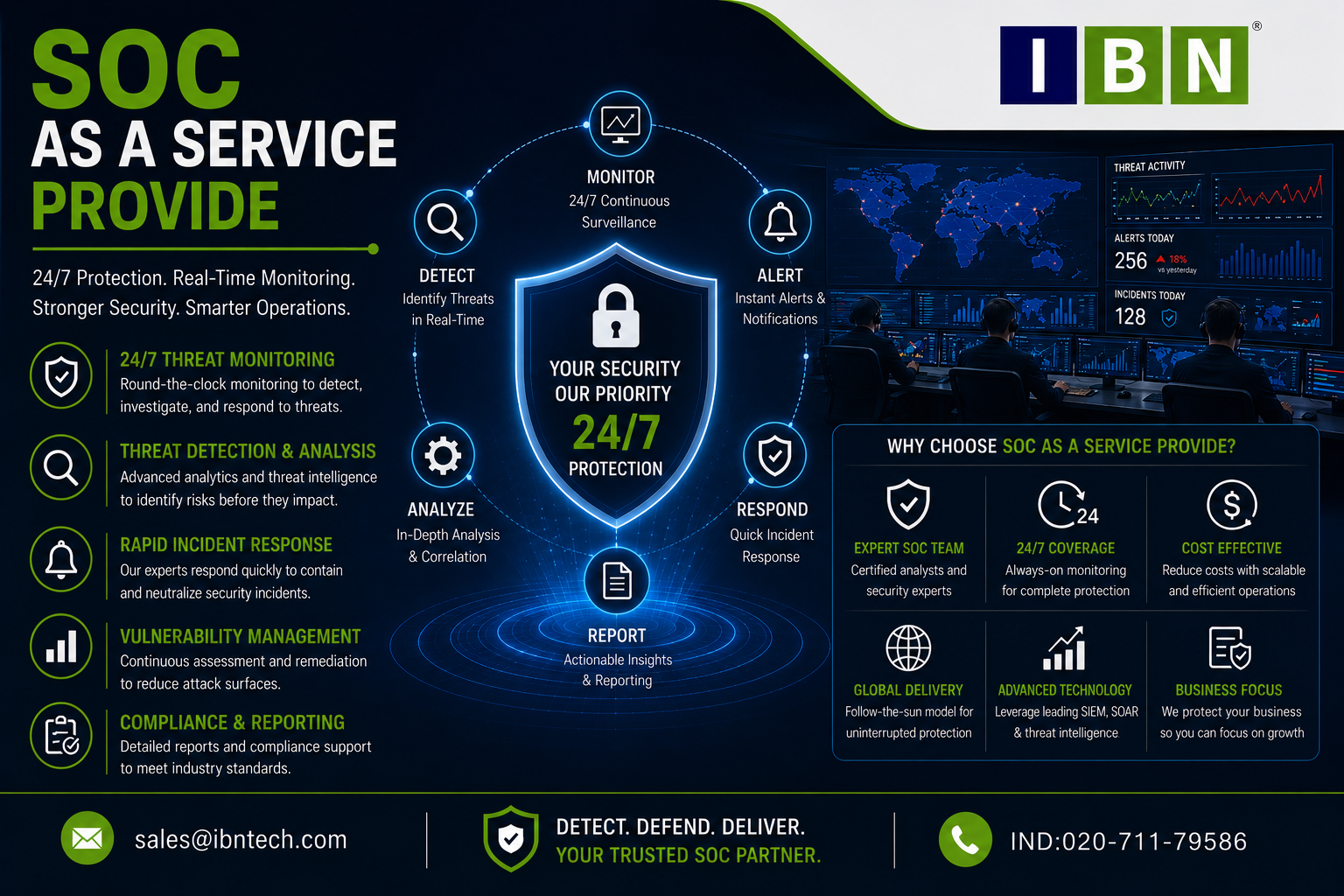
Soc as a Service Provider: Smart Choice vs In-House SOC in India
As cyber threats become more sophisticated, organizations need continuous security monitoring instead of relying solely on preventive security tools. Choosing a soc as a service provider has become an important consideration for IT leaders looking to improve cyber resilience while managing operational costs. For many businesses in India, the decision often comes down to one question: should they build an in-house Security Operations Center or partner with a managed SOC provider?
Both approaches aim to strengthen cybersecurity, but they differ significantly in terms of investment, scalability, expertise, and day-to-day management.
Understanding the Difference Between an In-House SOC and a Managed SOC
An in-house Security Operations Center is designed, staffed, and managed entirely by the organization's internal cybersecurity team. Every aspect—including technology deployment, analyst recruitment, infrastructure management, and continuous monitoring—remains the organization's responsibility.
A managed SOC, on the other hand, provides security monitoring, threat detection, and incident response through an external cybersecurity partner using dedicated security specialists and established operational processes.
For organizations experiencing rapid digital growth, In-House SOC vs Managed SOC is no longer only a technology discussion—it has become a strategic business decision.
Why Indian IT Organizations Are Reconsidering Traditional SOC Models
IT companies support cloud platforms, customer applications, software development environments, hybrid workplaces, and remote infrastructure. Each environment generates thousands of security events every day.
Several factors are driving organizations toward managed security services:
- Increasing ransomware attacks
- Cloud adoption across enterprises
- Shortage of cybersecurity professionals
- Growing compliance expectations
- Expansion of remote work environments
- Rising operational costs
Building internal capabilities to address these challenges requires substantial long-term investment.
Comparing the Two Approaches
The decision should be based on business objectives rather than assuming one model fits every organization.
|
Evaluation Factor |
In-House SOC |
SOC as a Service Provider |
|
Initial Investment |
High |
Lower upfront investment |
|
Infrastructure |
Organization-owned |
Managed by service provider |
|
Security Analysts |
Internal recruitment required |
Experienced analysts available |
|
Monitoring Hours |
Depends on staffing |
Continuous 24×7 monitoring |
|
Technology Updates |
Internal responsibility |
Managed as part of the service |
|
Scalability |
Slower expansion |
Easier to scale |
|
Operational Management |
Internal |
Shared with provider |
Organizations should evaluate both options based on security maturity, available resources, and business growth plans.
Where Traditional In-House SOCs Often Face Challenges
An internal SOC provides direct control over security operations but also introduces several ongoing responsibilities.
Recruitment and Skill Availability
Cybersecurity professionals with SOC experience remain in high demand.
Maintaining multiple shifts for continuous monitoring requires experienced analysts, incident responders, threat hunters, and SOC managers.
Recruiting and retaining these specialists can become challenging for many organizations.
Technology Maintenance
A Security Operations Center depends on multiple technologies, including:
- SIEM platforms
- Endpoint security
- Threat intelligence
- Security analytics
- Log management
- Automation tools
Keeping these technologies updated requires continuous investment and operational planning.
Continuous Monitoring
Cyber threats do not follow business hours.
Organizations relying only on daytime monitoring may experience delays in identifying suspicious activities occurring overnight or during weekends.
How a Soc as a Service Provider Addresses These Challenges
Managed SOC services are designed to provide continuous cybersecurity operations without requiring organizations to build every capability internally.
Services generally include:
Centralized Monitoring
Security events from servers, endpoints, firewalls, cloud platforms, and applications are collected into a centralized monitoring environment.
SIEM-Based Analysis
Security Information and Event Management (SIEM) technology correlates events across multiple systems to identify suspicious behavior.
Threat Hunting
Instead of waiting for alerts alone, analysts proactively search for indicators of compromise that automated tools may not immediately detect.
Incident Response Support
When threats are identified, security analysts investigate incidents and provide recommendations that help organizations respond efficiently.
IBN Technologies offers Managed SIEM and SOC Services that include continuous monitoring, SIEM-based event analysis, threat hunting, incident response, vulnerability management, user behavior analytics, and compliance-focused reporting.
Business Benefits Beyond Security
Partnering with a managed SOC provider supports broader business objectives as well.
Predictable Operational Costs
Organizations avoid large capital investments associated with establishing a dedicated Security Operations Center.
Improved Scalability
As cloud infrastructure, applications, or business operations expand, monitoring capabilities can grow without rebuilding internal security infrastructure.
Access to Experienced Security Teams
Organizations benefit from cybersecurity professionals who continuously monitor evolving threat activity across multiple environments.
Better Focus for Internal Teams
Internal IT departments can dedicate more time to business transformation initiatives while routine security monitoring is handled through managed services.
Practical Example
Consider a growing software company serving international clients.
The organization operates:
- Cloud-hosted applications
- Development environments
- Remote employees
- Customer support systems
- Multiple production workloads
Building a fully operational internal SOC would require recruiting analysts, implementing SIEM technology, maintaining infrastructure, and operating continuous monitoring.
A managed SOC enables the organization to strengthen cybersecurity while allowing internal technology teams to focus on product development and customer delivery.
Checklist for Evaluating Your SOC Strategy
Before deciding between an in-house SOC and a managed service provider, consider the following:
- Do you require 24×7 monitoring?
- Can your organization recruit experienced SOC analysts?
- Do you have dedicated incident response processes?
- Is SIEM technology already implemented?
- Can your team manage ongoing platform updates?
- Are compliance reporting requirements increasing?
- Will your security operations need to scale in the next few years?
- Do internal teams have enough capacity for continuous monitoring?
Answering these questions helps organizations identify which operating model best aligns with their cybersecurity goals.
Compliance Considerations
Indian organizations increasingly operate under stricter cybersecurity expectations from customers, partners, and industry regulations.
Continuous monitoring, centralized event management, incident response readiness, and structured reporting support stronger governance while improving operational resilience.
For CIOs, CISOs, and IT leaders evaluating future cybersecurity investments, a soc as a service provider offers an effective alternative to building and maintaining a fully staffed in-house Security Operations Center. By combining managed SIEM capabilities, continuous monitoring, experienced analysts, and scalable operations, organizations can enhance their security posture while supporting long-term business growth in India's rapidly evolving digital landscape.
Contact Us:
IBN Technologies LLC:
E-mail: - sales@ibntech.com
 Romaian
 English
 Arabic
 French
 Spanish
 Portuguese
 Deutsch
 Turkish
 Dutch
Dutch
 Italiano
 Russian
 Portuguese (Brazil)
 Greek
Greek
