


Europe Ammonia Market Forecast: Green Production and Industrial Demand Through 2035
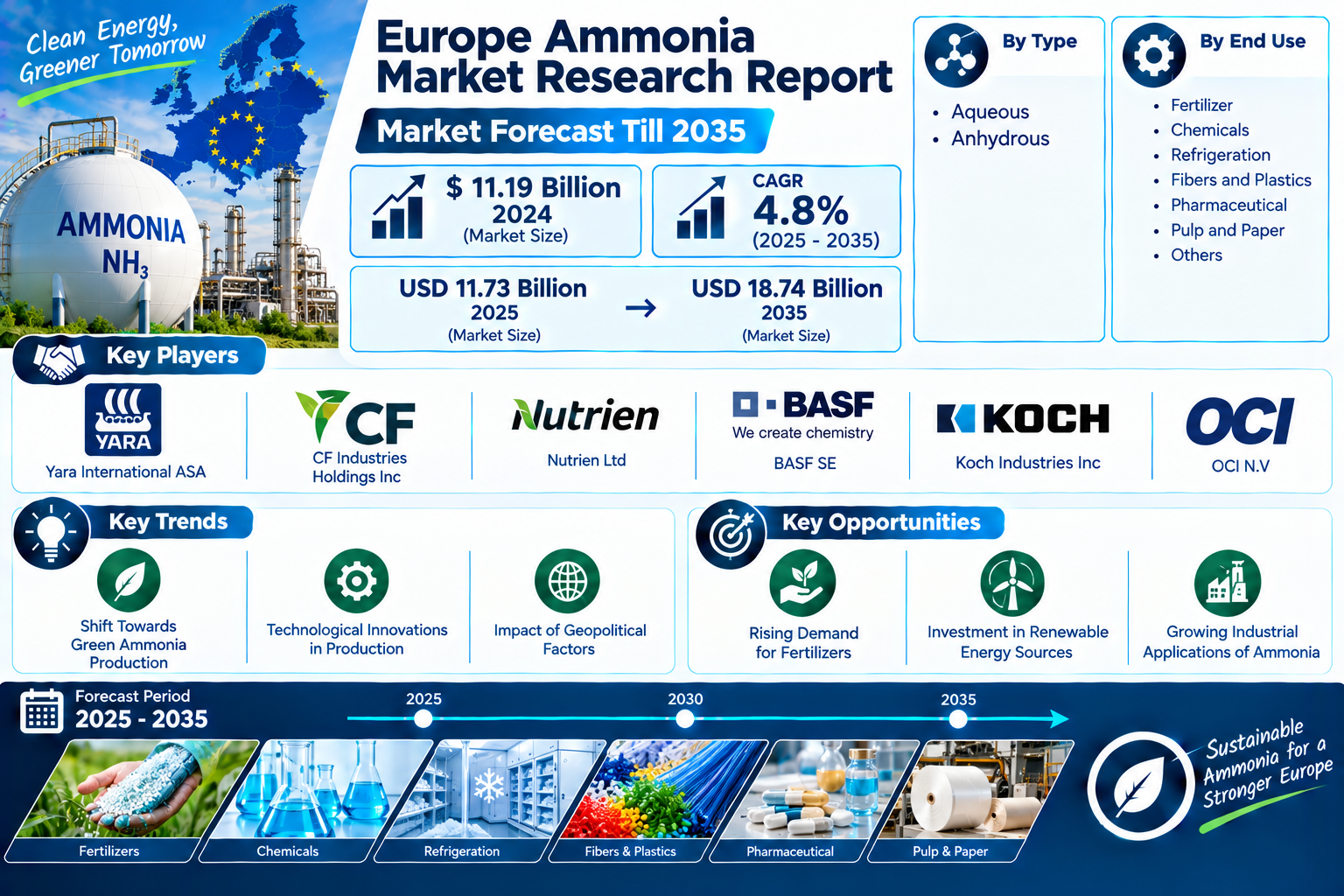
According to Market Research Future® (MRFR), the Europe Ammonia Market is expected to experience steady growth through 2035, supported by its established role in fertilizer production and its expanding relevance across industrial applications. Ammonia is an important chemical input for agriculture and several manufacturing activities, making its demand closely connected to food production, industrial output and developments in chemical processing. The European market was valued at USD 11.19 billion in 2024 and is projected to reach USD 11.73 billion in 2025. By 2035, it is expected to increase to USD 18.74 billion, registering a compound annual growth rate (CAGR) of 4.8% during the 2025–2035 forecast period.
Fertilizer Demand Remains a Core Market Driver
Agriculture represents a major source of ammonia demand because the chemical is a key feedstock for nitrogen-based fertilizers. These fertilizers supply nutrients that support crop development and agricultural productivity. As European food systems seek reliable agricultural output, fertilizer availability remains an important consideration for farmers, fertilizer producers and policymakers.
Demand for ammonia in fertilizer manufacturing is influenced by agricultural activity, crop nutrient requirements, fertilizer prices and the economics of production. Changes in natural gas and energy costs can also affect ammonia manufacturing expenses, since conventional production processes are energy-intensive. These cost relationships can influence producer operating decisions and the competitiveness of fertilizer products in regional markets.
The importance of fertilizer applications provides a relatively established foundation for the Europe ammonia market. However, the sector is also navigating changes in energy sourcing, environmental expectations and supply-chain conditions. Producers must balance the need to maintain reliable supplies with growing interest in reducing the emissions associated with ammonia production.
Aqueous and Anhydrous Ammonia Serve Different Needs
The market is segmented by type into aqueous and anhydrous ammonia. Aqueous ammonia consists of ammonia dissolved in water and is used in applications where a liquid solution is suitable. Its handling and concentration requirements differ from those of anhydrous ammonia, which contains ammonia without water and is commonly managed as a pressurized or refrigerated substance depending on storage and transport conditions.
Anhydrous ammonia is particularly important as an industrial feedstock and in fertilizer production. Its high ammonia concentration makes it suitable for chemical manufacturing and other uses that require ammonia as a direct input. Aqueous ammonia has applications in selected industrial processes and other settings where the solution form is appropriate. Product selection depends on the intended use, required concentration, handling infrastructure and applicable safety procedures.
The distinction between these forms has commercial and operational implications. Storage, transport, equipment compatibility and safety management must be considered throughout the supply chain. Producers and distributors therefore serve customers with different specifications and handling capabilities, making product quality and reliable logistics important aspects of market participation.
Industrial Applications Broaden the Demand Base
Beyond fertilizer manufacturing, ammonia is used across several industrial sectors. The end-use segmentation includes chemicals, refrigeration, fibers and plastics, pharmaceuticals, pulp and paper, and other applications. This diversity connects the market to a broad range of manufacturing and processing activities.
In the chemicals sector, ammonia serves as a building block for various downstream products and chemical processes. Its role as an industrial feedstock links demand to the performance of related manufacturing industries. Refrigeration is another established application, particularly in industrial systems where ammonia is used as a refrigerant. Its thermodynamic properties make it relevant to selected large-scale cooling requirements, although system design, safety controls and regulatory compliance remain essential.
Applications in fibers and plastics, pharmaceuticals, and pulp and paper add further sources of demand. The volume required by each sector depends on its production activity, process specifications and the availability of alternative materials or technologies. This range of applications can help diversify the market beyond agricultural demand, while also exposing ammonia consumption to changes in industrial production and operating costs.
Green Ammonia Emerges as a Strategic Trend
The shift towards green ammonia production is one of the most significant trends influencing the European market. Conventional ammonia production generally relies on fossil-fuel-based hydrogen and is associated with substantial carbon emissions. Green ammonia uses hydrogen produced through renewable-powered electrolysis, with nitrogen obtained from the air. The process can reduce production-related emissions when supported by low-carbon electricity and suitable infrastructure.
Europe's renewable energy ambitions and decarbonization objectives are encouraging interest in alternative production pathways. Green ammonia may become increasingly relevant to fertilizer manufacturers and industrial users seeking to reduce the carbon footprint of their supply chains. Its wider adoption, however, depends on renewable electricity availability, electrolyzer investment, production costs, infrastructure development and the establishment of dependable commercial supply arrangements.
Technological innovations in production are also shaping industry development. Improvements in process efficiency, equipment performance and the integration of renewable energy can influence the economics of ammonia manufacturing. Producers are assessing how new technologies can support lower-emission operations while maintaining output reliability and product quality.
Geopolitical Factors and Supply-Chain Considerations
Geopolitical factors represent another important influence on the Europe ammonia market. International energy trade, regional conflicts, trade policies and disruptions to transport routes can affect the availability and cost of natural gas and other essential inputs. Because ammonia production is energy-intensive, changes in energy supply conditions can influence operating costs and regional competitiveness.
Trade flows also matter because European consumers and producers participate in an interconnected global market. Shifts in import availability, logistics costs and supplier relationships can affect procurement strategies. Companies may place greater emphasis on supply diversification, inventory planning and long-term sourcing arrangements to manage uncertainty.
Competitive Landscape
Key companies identified in the Europe ammonia market include Yara International ASA, CF Industries Holdings Inc, Nutrien Ltd, BASF SE, Koch Industries Inc and OCI N.V. These participants operate across fertilizer, chemicals and related industrial value chains. Their activities and market roles differ, but their presence reflects the importance of established production capabilities, distribution networks and customer relationships.
Competition is influenced by production efficiency, access to feedstocks, energy costs, product availability and supply reliability. The transition towards lower-emission ammonia may also increase the importance of renewable energy access, technology investment and partnerships across the energy and chemical sectors.
Opportunities and Market Outlook
Rising fertilizer demand remains a key opportunity, while investment in renewable energy sources could support the development of green ammonia capacity. Growing industrial applications provide another potential avenue for market expansion, particularly where ammonia remains an important chemical input or process material.
The Europe ammonia market is projected to reach USD 18.74 billion by 2035, growing at a CAGR of 4.8% from 2025 to 2035. Its long-term development will depend on fertilizer consumption, industrial activity, production economics and the pace of the energy transition. The combination of established applications and investment in lower-emission production is expected to shape the market's direction over the forecast period.

 English
 Arabic
 French
 Spanish
 Portuguese
 Deutsch
 Turkish
 Dutch
 Italiano
 Romaian
 Portuguese (Brazil)
 Greek