


Could Healthcare Become One of the Biggest Winners of 3D Printing?
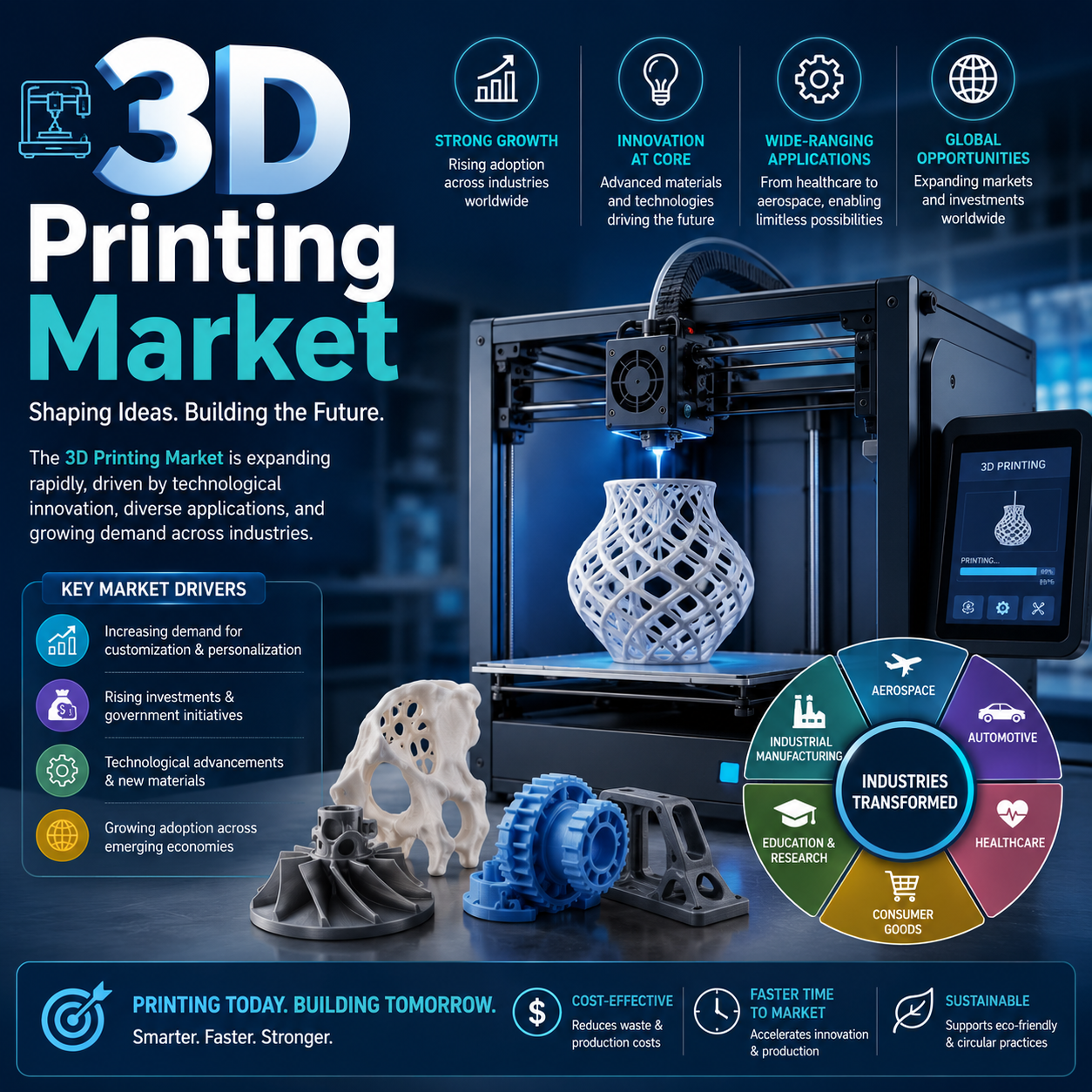
Healthcare is moving toward increasingly personalized treatment, and manufacturing technology is evolving alongside it. The 3d Printing Market is opening new possibilities for patient-specific models, customized medical products, prosthetics, dental applications, and emerging bioprinting research. According to 6Wresearch, healthcare is expected to be among the faster-growing verticals in the global market, with the segment projected to achieve a CAGR of approximately 10.5% between 2026 and 2032.
Why Healthcare Needs Customization
Every patient is different.
Traditional manufacturing often produces standardized medical products in predefined sizes. While this works for many applications, some patients require solutions that match individual anatomy.
3D printing can translate digital medical data into physical objects.
For example, doctors can use patient-specific anatomical models to understand complicated structures before surgery.
This can support planning and communication.
Prosthetics With a Personal Touch
Prosthetics are another important application.
A patient's body shape, comfort requirements, and lifestyle can vary considerably.
Additive manufacturing can support customized designs that are digitally modified according to individual requirements.
The ability to create customized shapes without developing expensive molds can make the technology particularly attractive for personalized healthcare products.
Dental Manufacturing Is Going Digital
Dentistry has already become increasingly digital.
Scanners can capture detailed information about a patient's teeth, while digital software can create models for dental applications.
3D printing can then turn those designs into physical products.
This digital workflow can reduce certain manual steps and potentially accelerate production.
The broader trend is clear: healthcare manufacturing is becoming increasingly connected to digital data.
Surgical Planning and Medical Education
3D printed anatomical models can also support medical training.
Instead of relying only on two-dimensional images, students and doctors can examine physical models representing complex structures.
Surgeons can potentially use patient-specific models to study difficult procedures before entering the operating room.
This creates an interesting connection between manufacturing and medical decision-making.
The Promise of Bioprinting
Perhaps the most futuristic area is bioprinting.
Researchers are exploring whether biological materials and cells can be organized using printing technologies to create tissue structures.
The objective is ambitious: develop systems that could eventually contribute to regenerative medicine and other advanced healthcare applications.
This field remains highly complex and should not be confused with commercially established medical printing.
Nevertheless, its long-term potential is enormous.
Why Materials Matter So Much
Healthcare applications require exceptionally careful material selection.
Materials may need to demonstrate biocompatibility, durability, sterilization compatibility, and other specific properties.
This is one reason the development of specialized materials is central to the industry's evolution.
6Wresearch identifies materials as the largest overall offering segment of the global 3D printing market, highlighting how important material innovation is across applications.
Regulation Cannot Be Ignored
Healthcare products can have direct consequences for patient safety.
Therefore, regulatory approval, quality assurance, traceability, and manufacturing consistency are essential.
A prototype may be produced quickly, but turning that prototype into an approved medical product requires extensive validation.
Companies entering healthcare additive manufacturing need both technological expertise and regulatory knowledge.
The Digital Healthcare Factory
The future healthcare facility could look very different from today's manufacturing environment.
Imagine a hospital connected to digital scanning, design software, certified materials, and advanced printers.
Selected products could potentially be manufactured closer to the point of care.
This could support faster customization and reduce dependency on centralized manufacturing for certain applications.
Challenges Ahead
Healthcare 3D printing still faces significant obstacles.
Material limitations, certification requirements, machine costs, quality control, and workforce skills can slow adoption.
Bioprinting faces even more complicated scientific and regulatory challenges.
But these barriers also create opportunities for companies developing specialized software, materials, printers, and quality-control systems.
A Personalized Future
6Wresearch projects healthcare to be among the faster-growing verticals through 2032, while the overall market is expected to more than double from USD 21.5 billion in 2025 to USD 46.2 billion by 2032.
The most important contribution of 3D printing to healthcare may ultimately be personalization.
Instead of asking, “What standard product fits this patient?” future healthcare manufacturing could increasingly ask, “What product should be designed for this patient?”
That shift could make additive manufacturing one of the most transformative technologies in personalized medicine.
Who We Are
About 6Wresearch: It is a commercial strategy and growth advisory firm founded in 2011 and headquartered in New Delhi, India, with partners across Southeast Asia and the Middle East & Africa. The firm has delivered over 20,000 commercial engagements for over 2,000 organizations, including Fortune 500 companies, government agencies, and multilateral institutions such as the World Bank and the Asian Development Bank. 6Wresearch combines proprietary intelligence, advanced analytics, and sector expertise to help organizations navigate market complexity and drive sustainable growth. These capabilities explain why organizations trust 6Wresearch for reliable commercial insights and confident decision-making.
Our Proprietary Platform: 6W Export GTM
6W Export GTM is 6Wresearch's proprietary trade intelligence and go-to-market platform, built on UN Comtrade data and enhanced with 6Wresearch's in-house analytical and simulation models, including system dynamics-based forecasting. Unlike broad, sector-level market sizing tools, 6W Export GTM operates at the individual product level down to specific HS codes and micro-segments to identify precise, actionable export opportunities by country and product pair, including markets where trade currently does not exist. This granular, simulation-driven approach allows 6W Export GTM to surface opportunities that sector-wide analysis typically misses, positioning it among a small number of platforms globally offering this depth of product-and-country-specific export intelligence.
 Spanish
 English
 Arabic
 French
 Portuguese
 Deutsch
 Turkish
 Dutch
Dutch
 Italiano
 Russian
 Romaian
 Portuguese (Brazil)
 Greek
Greek
