


Europe Ammonia Market Growth: How Green Production Could Reshape the Industry
Europe’s Ammonia Industry Is Entering a Different Phase
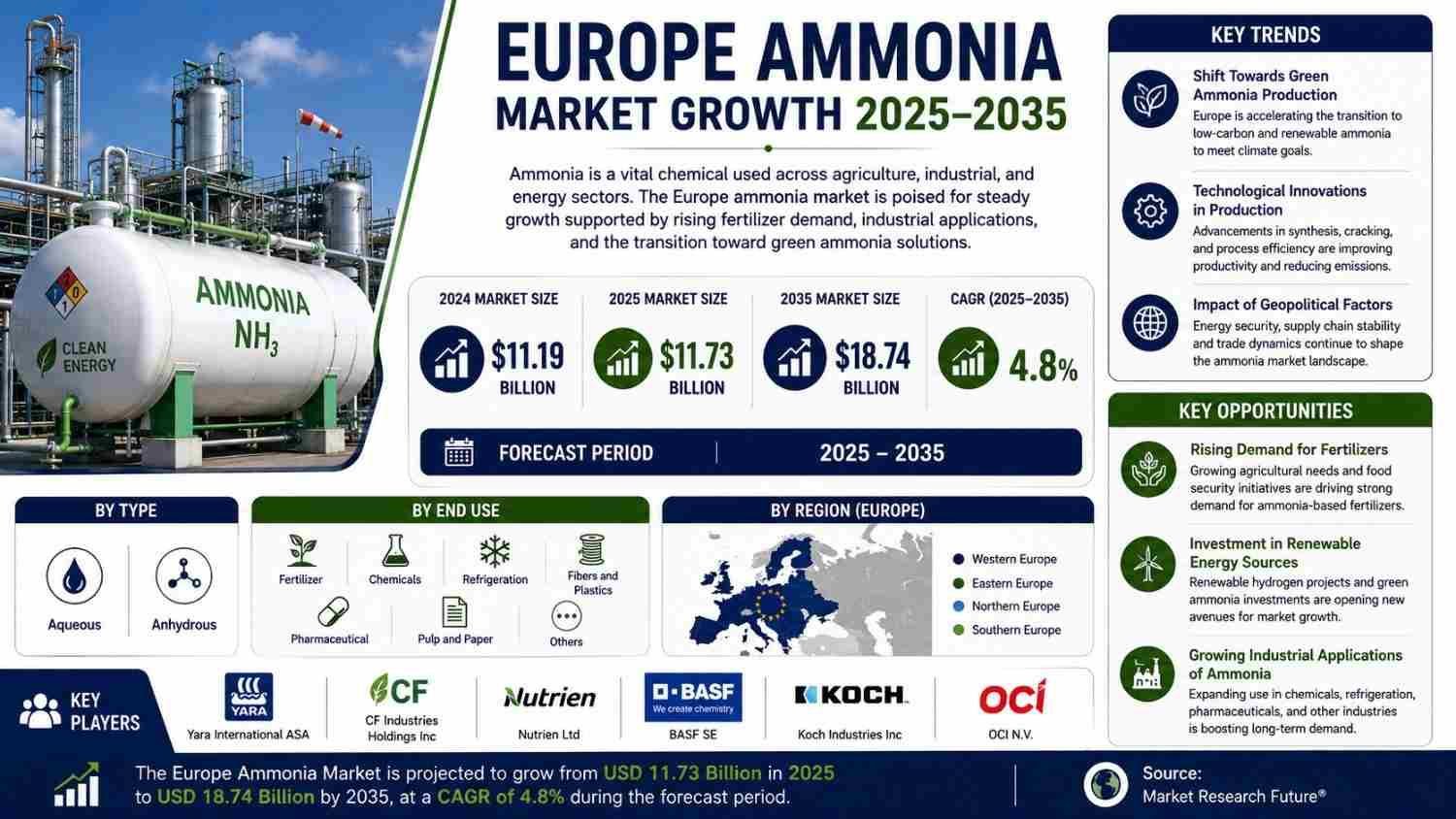
According to Market Research Future®, the Europe Ammonia Market was valued at $11.19 billion in 2024 and is projected to reach $11.73 billion in 2025 and $18.74 billion by 2035, registering a CAGR of 4.8% during 2025–2035. The market is being influenced by the shift toward green ammonia production, technological innovations, and geopolitical factors, while rising fertilizer demand, renewable energy investment, and expanding industrial applications create opportunities. Major companies include Yara International ASA, CF Industries Holdings Inc, Nutrien Ltd, BASF SE, Koch Industries Inc, and OCI N.V.
Ammonia has traditionally been associated with fertilizer production, but its role in Europe is becoming broader. The chemical remains essential to agriculture while also serving industrial applications such as chemicals, refrigeration, fibers and plastics, pharmaceuticals, and pulp and paper. At the same time, Europe is examining how ammonia production can become less dependent on conventional fossil-based energy systems.
Fertilizer Demand Remains the Foundation
Fertilizer is expected to remain a central end-use application because ammonia is a critical input for nitrogen-based fertilizers. Agricultural productivity depends on reliable access to these products, making ammonia strategically important even when production economics become difficult.
The challenge is that fertilizer demand and production costs are closely connected to energy markets. Conventional ammonia production requires substantial energy, meaning fluctuations in energy availability and pricing can influence the economics of European production.
This creates a difficult balance for producers. Agriculture needs reliable fertilizer supplies, while manufacturers need competitive energy and feedstock conditions.
Green Ammonia Changes the Investment Equation
The shift toward green ammonia is one of the most significant developments in the European market. Green ammonia generally refers to ammonia produced using hydrogen generated through renewable electricity rather than relying on conventional fossil-based hydrogen.
The attraction is clear: renewable electricity can potentially provide a pathway toward lower-carbon ammonia production. However, the transition requires significant investment in renewable power, electrolyzers, production facilities, storage, transportation, and related infrastructure.
The opportunity is therefore larger than simply replacing one production process with another. It involves creating an interconnected industrial system capable of producing and moving ammonia economically.
Renewable Energy Is Becoming Part of the Ammonia Story
Investment in renewable energy is directly relevant to the future of European ammonia. Green production requires access to electricity at a scale and cost that can support industrial operations.
This creates an important connection between the ammonia and renewable energy sectors. Regions with strong renewable generation potential may become attractive locations for new ammonia projects, while existing industrial centers may seek ways to connect low-carbon energy with established chemical infrastructure.
The economics will remain important. Renewable power availability, infrastructure, financing, technology costs, and utilization rates will influence whether projects can compete with conventional production.
Technology Can Improve Production Efficiency
Technological innovation is affecting both conventional and emerging ammonia production. Improvements in process efficiency, equipment, monitoring, and hydrogen production can influence the economics of future facilities.
For established producers, technology can help improve efficiency while companies gradually evaluate lower-carbon production options. For newer projects, technological development can determine whether green ammonia becomes commercially viable at larger industrial scales.
This makes research and engineering capability an important competitive factor.
Geopolitics Adds Another Layer of Complexity
Ammonia is connected to global agricultural and energy supply chains, making geopolitical developments relevant to European producers and buyers.
Europe's reliance on international sources of energy, raw materials, and industrial inputs can create exposure to external disruptions. This has increased the strategic importance of supply diversification and domestic production capability.
For ammonia producers, the issue is not simply where the product is manufactured. It is also whether energy, hydrogen, transportation, and supporting infrastructure can remain available under changing international conditions.
Industrial Applications Provide Additional Demand
Although fertilizer is a major application, ammonia also supports chemical manufacturing, refrigeration, fibers and plastics, pharmaceuticals, and pulp and paper.
These industries create demand that is less directly connected to agriculture. Industrial diversification can therefore strengthen the market by creating several consumption channels.
Some applications also have specific purity, handling, or supply requirements. This encourages producers and distributors to understand the technical needs of individual customers rather than treating ammonia as a single standardized demand category.
Aqueous and Anhydrous Ammonia Serve Different Needs
The market includes aqueous and anhydrous ammonia. Their physical characteristics and handling requirements influence where they are used.
Anhydrous ammonia is particularly relevant to fertilizer and industrial applications, while aqueous ammonia can serve other chemical and industrial purposes. The distinction affects storage, transportation, safety procedures, and infrastructure.
As European regulations and industrial requirements develop, producers and users will need to maintain careful control over handling and distribution.
The Competitive Landscape Is Changing
Yara International ASA, CF Industries Holdings Inc, Nutrien Ltd, BASF SE, Koch Industries Inc, and OCI N.V. are among the major companies shaping the competitive environment.
Competition is likely to increasingly involve both production economics and transition capabilities. Companies that can maintain reliable conventional supply while developing lower-carbon alternatives may be better positioned to manage the transition period.
Partnerships across energy, chemical, infrastructure, and industrial sectors may also become more relevant as green ammonia projects require capabilities beyond traditional ammonia manufacturing.
What Could Restrict Growth?
The transition faces several challenges. Green ammonia requires substantial capital investment and reliable renewable electricity. Infrastructure may need to be expanded or adapted, while new projects can take time to develop.
Conventional ammonia production also faces cost pressure from energy markets. Meanwhile, industrial customers may be cautious about paying premiums for lower-carbon products unless environmental requirements or market conditions justify the additional cost.
These factors mean that the market's growth will depend not only on demand but also on the ability to build commercially viable supply.
The Outlook Through 2035
The projected market value of $18.74 billion by 2035 indicates that ammonia will remain important to Europe's agricultural and industrial economy. But the more significant change is the way ammonia is produced and positioned within the energy system.
The European market is gradually moving from a question of how much ammonia is needed toward a more complex question: how can Europe secure ammonia supplies while reducing production-related emissions and maintaining industrial competitiveness? Companies that can address both sides of that equation will have a stronger role in the next phase of the market.

 English
 French
 Spanish
 Portuguese
 Deutsch
 Turkish
 Dutch
Dutch
 Italiano
 Russian
 Romaian
 Portuguese (Brazil)
 Greek
Greek
